Many Video Games set out to achieve something, be that to tell a story, show a different perspective OR, in this particular case, change a person’s views on a particular topic. This week, I am talking about an article by Gina Roussos on Psychology Today from back in 2015 (found here). It talks about how a piece of media can actually end up doing changing a person’s mind to think the exact OPPOSITE of what was intended.
The focus of the article is an online game intended to change a person’s thoughts on people in poverty. The game is called ‘Spent’ and tries to put the player into the shoes of a person below the poverty line, it intends to show the player the difficult decisions one in such a situation faces on a day to day basis. It does this while challenging the player to make it through a month (30 Days), starting off with only $1000. If you’re interested you can find it online here: http://playspent.org/
The Job Selection Screen, 3 selections, each just as bad as the others.
The article on Psychology Today goes through a study that was undertaken by the article’s author, Gina Roussos, to find if the game would have it’s desired effect. After a test involving 54 American Undergraduates and a Control Game called ‘Garbage Dreams‘, Roussos eventually found that the game actually had a negative impact on people’s views on the subject.
Roussos suggests that this is due to the fact that by putting a person into the driver’s seat of these situations it shows them that theses are decision that THEY have control over and any short-comings that then occur are due to their own bad decisions. This feeling of control over one’s outcomes is called “Personal Agency”. It is this feeling that draws people to believe that poverty is personally controllable, and again, is only the result of a person’s decisions.
The example Roussos gives is as follows: “When I’m playing a game, I feel like I have complete control over my outcomes. I click on Door A instead of Door B, and I find a treasure chest full of jewels. I found that treasure because I choose Door A.” The above showcases the choice that YOU, the player, picked Door A. Door A happened to contain a treasure chest. But had you picked Door B then you would never have found said treasure.
The End Screen for ‘Spent’, showing how much you made it through the month with but also makes sure you know that Rent is due tomorrow.
This then provides the inherent problem with the game itself. It pushes the player to make the decisions on the spot without any prior knowledge of the event in question. Then you instantly see the ramifications of your decision, pushing the idea being in poverty is a result of a person’s bad decisions. Henceforth proving that the Game’s intentions are very much different to it’s actual effect.
Roussos then goes on to do another study with 227 U.S. Adults to verify these results. Although apparently when people watched a recording of someone playing the game they reacted in more of a way that the Developers intended. The people viewing the game being played second hand showed a more empathetic view towards people in Poverty than the people actually playing it.
After playing the Game myself for 10-15 minutes I find the game itself to be kind of unreasonable to it’s events and does indeed instil a feeling the opposite of what was intended. I felt like the game was punishing me simply because of the decisions I made NOT because of the situation I was in as a character.
But as for the article it was a very good insight into the intentions of the Game and it’s actual effect on people. It’s also a good insight into the repercussions of not testing out your Game’s effect when it’s effect is the desired outcome.
But that’s it for this week, thanks for reading everyone! I’ll be back next week with a review of ‘Dwarf Fortress’ by Bay12.
Diegesis in Video Games refers to the Narrative elements within the game itself. There are then Intra-Diegetic and Extra-Diegetic. Intra-Diegetic refers to elements of the game that belong to the game’s world, examples of this are the Characters themselves, the environment and items, these are things that can be perceived by the Game’s Characters. Whereas Extra-Diegetic refers to the elements of the game that don’t belong to the world itself, such as menus, music and the HUD, these are things that can NOT be perceived by the Game’s Characters. These elements do not always stick within these boundaries though.
I stumbled across an article by Gregory Weir on Gamasutra.com from November 2008 exploring the Diegesis of the LucasArts’ game Grim Fandango, the article itself can be found here. This week I’ll be posting a response to said article.
Weir begins the article by mentioning the split in the world inhabited by a Game’s Characters and the world that is shown to the player. The way this is shown is by using Intra-Diegetic and Extra-Diegetic elements. Weir explains the term Diegesis within a Film context by mentioning Music specifically. If a character directly plays a certain song, be that via instrument or player of some sort, then that is Diegetic music. Whereas if it is moreso background music then that would be non-diegetic.
Weir goes on to mention how Diegesis works in Video Games. As I previously stated there are many different attributes of Games that can be shown as Diegetic. It is these attributes that contribute to, or take away from, the immersion that any developer may be trying to achieve.
Many games use Diegesis to add to this immersion factor. The ‘Fallout Series’ features an item known as a ‘Pip Boy’ a device in the game used to manage inventory and character traits, now this is only Diegetic because the character raises their arm when the player presses the Inventory button. It is this acknowledgement that makes the action Diegetic. Much like in ‘Goldeneye’ for the N64, Bond raises his arm to look at his watch which then acts as a pause menu among other things. Both of theses are examples of Diegetic attributes.
Pip Boy Usage in ‘Fallout 4’ by the Player Character
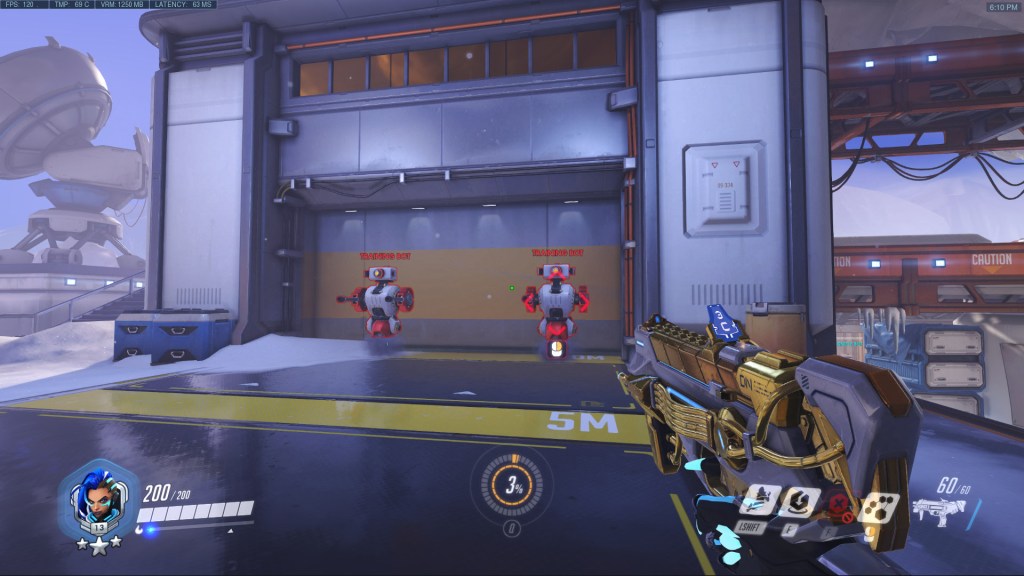
Another example is within the Blizzard game ‘Overwatch’. Characters that use guns sometimes have visual markers on their guns that show their current ammo count. While this isn’t a necessary addition due to the game’s HUD also having a more traditional ammo count featured in the bottom right hand corner, it goes to show the character’s personalities more than otherwise shown. With ‘Overwatch’ being an FPS game the player does not see much of the character they are playing besides their hands and their weapon for the most part. An example can be seen below with Sombra’s weapon. Most skins feature a hexadecimal counter that represents her current ammo count, this plays into her character trait being a hacker of sorts.
The “3C” at the top of the gun means 60 as a Hexadecimal
The “28” at the top of the gun means 40 as a Hexadecimal
Screenshots of Sombra’s Cyberspace Skin Showing the usage of Hexadecimals to show ammo count and Character Personality.
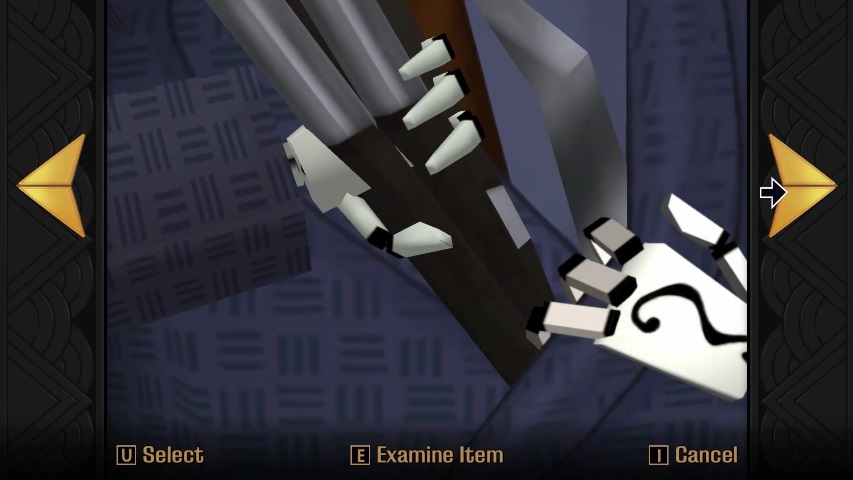
In the case of LucasArts’ ‘Grim Fandango’, the main example of Diegetic usage is the inventory. Weir writes that the player character, Manny, will individually pull any given item out of his coat as the player goes through the inventory. Manny will put each one away as well before pulling out the next. This is a great example of Diegetic techniques as it involves the player character in an event that normally only involves the player.
Grim Fandango Inventory example, Manny pulling out his Scythe that he “Likes to keep where his heart was”
Diegesis is not always a constant plus in Video Games. To stick with Grim Fandango for a minute, the inventory system that is present isn’t the most user friendly. Weir also touches on the fact that during some parts of the game Manny’s inventory may be packed to the brim with items so having to sort through every single one individually is awfully time consuming and is not very ergonomic for the player. It is also more than likely working against it’s intended purpose of bringing the player into the Game’s World and is instead pushing them away somewhat.
Another example of Diegesis working against the player is in the most recent ‘Animal Crossing’ release. ‘Animal Crossing: New Horizons” features both an inventory and crafting system. At maximum the player can have 40 different items in their inventory and any number of items in their house storage. But when it comes to crafting the player MUST have the required items in their inventory to craft anything. This, again, works against the player if they are crafting within their own home. It just makes sense from a gameplay point of view for a crafting area within the same place as the storage to be able to interact with said storage. This would remove the middle man, this being the player action of removing things from storage to craft, completely, allowing for a more streamlined experience.
As I mentioned earlier, Diegesis is a method of bringing the player closer to the game, to immerse the player in the game’s world. To bring the player into that “Magic Circle”. Weir speaks about how the developer can remove non-Diegetic elements to “make it easier for the player to lose herself in the game”. That being said, Weir also prods into the idea that there can be high-level immersion and player investment in a game that is mostly non-Diegetic.
In the case of ‘Grim Fandango’, the game definitely would have been more player-friendly had it utilised a more conventional inventory system. Weir can be quoted saying “In this case, immersion would probably be restored by using an easier but less Diegetic inventory system. This would undermine Grim Fandango’s goal of creating a cinematic experience, but it would make the game less frustrating and easier to use.”.
Diegesis is an important thing for Developers to consider when it comes to creating a Game as a user experience. Especially the thought of when it is best to use it, should this attribute be Diegetic or non-Diegetic? That is a question that the Developer should be thinking about.
That’s it for this article, thank you once again for reading! I’ll be back soon with another article about Procedural Generation in Video Games.
This week I have been looking into the development cycle of video games, auteurs and production in general. In that vein I have found a neat series on YouTube titled “Devs Play” by DoubleFineProd. Double Fine Productions is a Video Game developer based in San Francisco and owned by Xbox Game Studios as of 2019.
The series itself involves the CEO of DoubleFineProd, Tim Schafer, sitting down and playing Video Games with fellow Game Developers, my episode of choice for this article is titled “Devs Play S2E08 · “Jak and Daxter” with Jason Rubin and Tim Schafer”. This involves Tim Schafer chatting with Naughty Dog co-founder Jason Rubin about his Playstation 2 Classic, ‘Jak and Daxter: The Precursor Legacy’.
Devs Play S2E08 by DoubleFineProd
The ‘Jak and Daxter’ series is one of my all time favourites. ‘Jak II: Renegade’ was the first game I owned on my Playstation 2 back in 2005 and has definitely helped shape me into the person and gamer I am today. I would soon enough go on to try the sequel ‘Jak 3’ and the prior instalment, and the featured game for this post, ‘Jak and Daxter: The Precursor Legacy’. I adore the series and have played all the games (yes including ‘Jak and Daxter: The Lost Frontier’). But enough about me.
Firstly, a bit of a run down of Naughty Dog’s repertoire prior to the development of ‘Jak and Daxter’. Avid programmers, Jason Rubin and Andy Gavin, having played around with C++ and Lisp and founded JAM Software (which stood for “Jason and Andy’s Magic Software”) in 1984. After several releases through Publisher such as Baudville and Electronic Arts Jason and Andy renamed the studio to ‘Naughty Dog’ in 1989. Between then and 2001 when ‘Jak and Daxter: The Precursor Legacy’ was released, Naughty Dog developed the following titles while under Universal Interactive Studios;
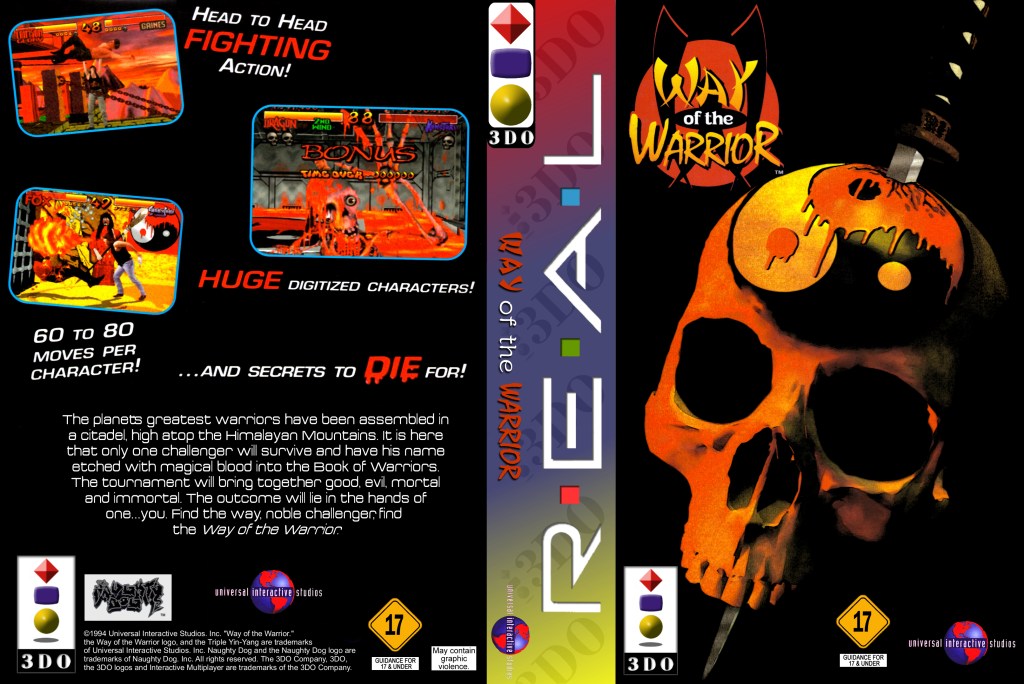
‘Way of the Warrior’ for the 3DO
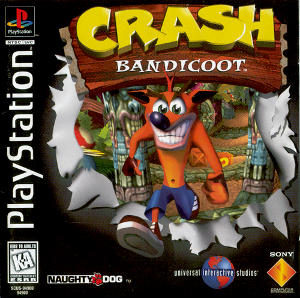
‘Crash Bandicoot’ for the Playstation
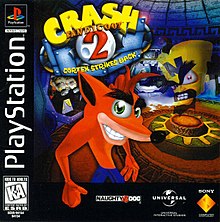
‘Crash Bandicoot 2: Cortex Strikes Back’ for the Playstation
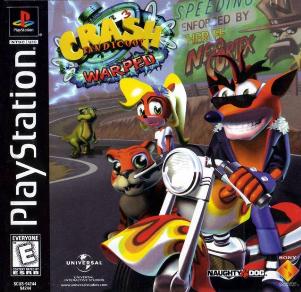
‘Crash Bandicoot 3: Warped’ also for the Playstation
‘Way of the Warrior’ Cover Art for the 3DO Console
Between the release of ‘Crash Bandicoot 3: Warped’ and ‘Jak and Daxter’, Naughty Dog also released ‘Crash Team Racing’ for the Playstation, which was published by Sony Entertainment. During the game’s 8 month and 6 day development cycle, Naughty Dog spoke to Sony and managed get them to not only get the rights to the Crash Bandicoot IP from Universal (who owned the rights due to the prior deal with Naughty Dog) but also straight out bought Naughty Dog as a whole later in 2001.
Then came the fateful day ‘Jak and Daxter’ released to the public. December 3rd 2001.
The game was being developed over a 3 year period, the engine for which began development back during the development of ‘Crash Team Racing’. With co-founder Andy Gavin and fellow programmers, Steven White and Mark Cerny taking the helm on the project.
Naughty Dog had the vision to create a Character Driven, Open World, Action Adventure Game. After Sony saw the game they told Naughty Dog that they didn’t want it to be like ‘Crash Bandicoot’. They wanted something that they didn’t have to license for any number of titles, they wanted something that wouldn’t eventually show up on a competitor’s platform. Most importantly, they wanted something that would remain a permanent member of the Sony Universe.
The Naughty Dog team itself had grown from an 8 man Team during the development of Crash Bandicoot to a Team of roughly 40 that developed ‘Jak and Daxter’. Another part of growth of Naughty Dog between these two games is that ‘Jak and Daxter’ used actual animators, while the animations for Crash himself in the original title were done by co-founder Jason Rubin. On that note, ‘Crash Bandicoot’ featured a unique animation for almost every single death that could happen to the player, and Crash. Likewise, ‘Jak and Daxter’ featured a vast array of quips by the side-kick of the series, Daxter.
Since Naughty Dog had hired a group of actual animators for the development of ‘Jak and Daxter’, Jason was relegated from animator to developing Particle Systems with half of his time, and managerial tasks with the other half.
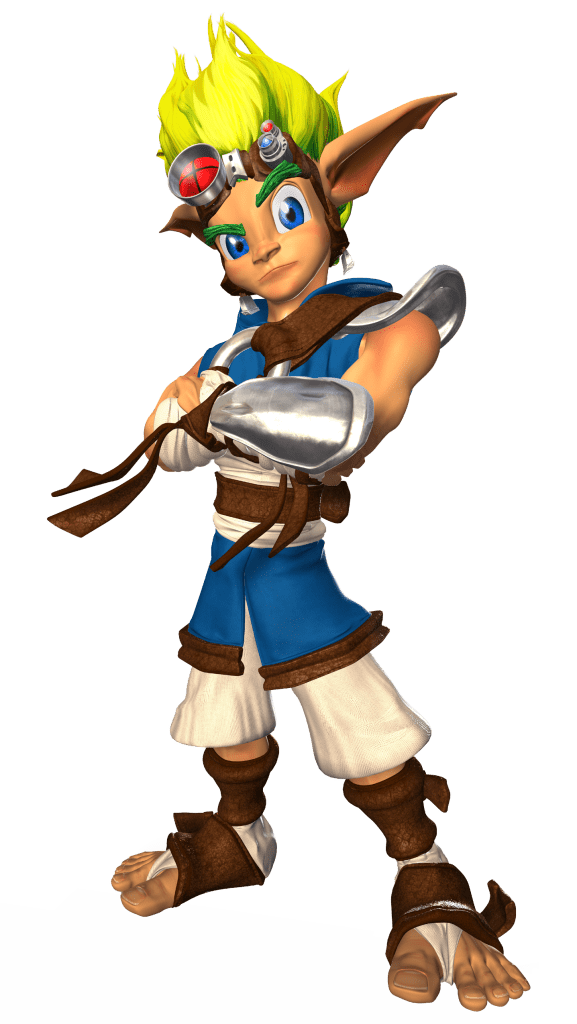
The Protagonist of the Series: Jak
As for the design of the main character, Jak, Naughty Dog took a more committee based approach. While developing ‘Crash Bandicoot’ Naughty Dog had cartoonists Charles Zembillas and Joe Pearson develop the character, creating a firm vision of who the character Crash is. Whereas when creating Jak’s character Naughty Dog took advantage of Focus Groups to get ideas and references from different regions. This meant that Jak’s design went through 4 different groups. Naughty Dog themselves, Sony America, Sony Japan and Sony Europe. This caused a lot of confusion and while Jason does go on to say that Jak is a solid character (and I love the character myself) but he definitely could have benefited from a clearer vision.
Two aspect’s of Jak’s design that came from the committee are his face and ears as a whole. They were made to look more ‘cartoonish’ to be more ‘Japanese friendly’.
The Side-kick of the Series: Daxter
Daxter on the other hand was developed with a single vision, Jason states that he thinks that Daxter is a stronger character because of that fact. Daxter himself was included in the game as a sort of comic relief and also someone that can do whatever he wishes. This separates Jak and Daxter as Jak himself is a mute in the first game. Jason mentions “…having the main character talk would distance you from the main character. ‘I’m not that character, he cracked a bad joke or said something I wouldn’t have necessarily said in that position’.”. So the player is meant to find themselves linked to Jak in a different kind of way to most Video Game Protagonists, especially at the time. This also allows for the Main Character to be likeable as he can’t do or say anything that the player wouldn’t do otherwise. Having your Main Character be likeable is a big step in the right direction.
The dynamic between Jak and Daxter was more intense during development, the game originally allowed the player to kick Daxter to “shut him up”, but this was removed before release. The two would grow to be more equal on the talking and character front in future releases as Jak would begin talking at the beginning of the sequel; ‘Jak II: Renegade’.
Naughty Dog itself has a bit of a reputation for…odd, naming philosophies. Crash Bandicoot 1-3 go by the following names:
‘Crash Bandicoot’
‘Crash Bandicoot 2: Cortex Strikes Back’
‘Crash Bandicoot 3: Warped’
Crash Bandicoot PS1 Cover Art
Crash Bandicoot 2 PS1 Cover Art
Crash Bandicoot 3 PS1 Cover Art
As shown in the Box Art and names listed above, Naughty Dog like mixing it up with naming their games. This is no different for the ‘Jak and Daxter’ Series, of which there is the following:
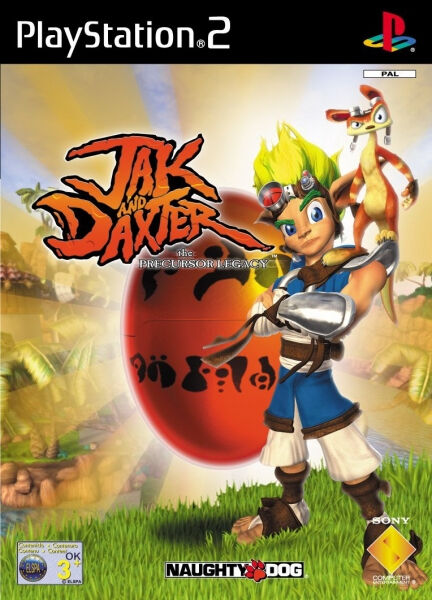
‘Jak and Daxter: The Precursor Legacy’
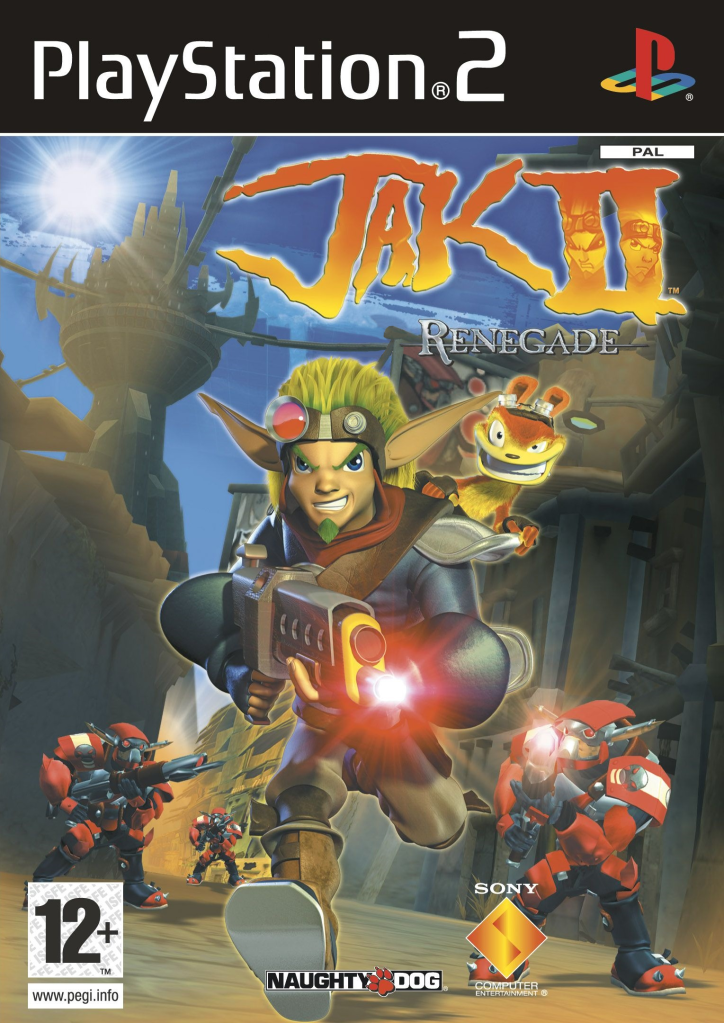
‘Jak II: Renegade’
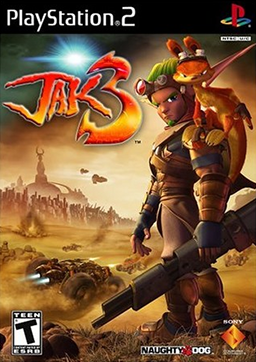
‘Jak 3’
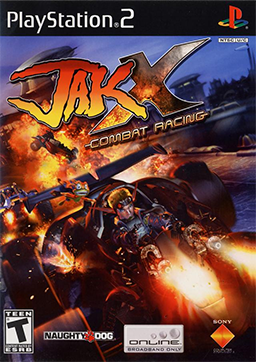
‘Jak X: Combat Racing’
‘Jak 2: Renegade’ PS2 Cover Art
‘Jak 3’ PS2 Cover Art
‘Jak X: Combat Racing’ PS2 Cover Art
‘Jak and Daxter: The Precursor Legacy’ PS2 Cover Art
As shown, once more, by the Box Art and names listed, there is even more variation in naming philosophies. ‘Jak and Daxter: The Precursor Legacy’ and ‘Jak II: Renegade’ both utilise a subtitle (1 – ‘The Precursor Legacy’ and 2 – ‘ Renegade’), while ‘Jak 3’ drops the subtitle and even uses a number “3” in the title while ditching the roman numerals used in ‘Jak II: Renegade’. While they change their minds again in ‘Jak X: Combat Racing’ or just ‘Jak X’ in Eurpoe and Australia.
That’s it for this week, I hope you enjoyed the read. I’ll be posting again soon! If you want to watch the featured video then feel free to check out the video below!
Over the years since the late 2000s the interest of gaming has moved into much less of a niche position. People anywhere and everywhere have picked up an interest in gaming. From children as young as 2 (I started at 4 in the early 2000s) to the elderly, picking up games such as Skyrim and slamming hours upon hours into the game (for example; Shirley Curry ).
“SKYRIM eps 1” By Shirley Curry as Mentioned above.
Since the rise in popularity of gaming many a term has come to describe someone that plays games, to any extent. All of these labels come under the heading of, “Gamer”. With the labels themselves consisting of Hardcore Gamers and Casual Gamers, amongst other things.
The label “Casual Gamer” refers to someone who plays games at a low level, not talking skill-wise, but time invested wise. A lot of these players tend to play mobile games as they are the most easily played on and off throughout the day in small bursts. These “Casual Gamers” tend to get a lot of flak from most other Gamer variants, especially the “Hardcore Gamers”. This is mostly due to the “Hardcore Gamers” think that the casuals (as they are referred to) have not put anywhere near enough time into the game to understand it at a high level. Therefore casuals and their opinions are often disregarded.
“Hardcore Gamers” on the other hand, are the complete opposite end of the spectrum. “Hardcore Gamers” are the players that devote obscene amounts of time into a game and understand the game at a very highly developed level. “Hardcore Gamers” often spend hours upon hours of time into any given game, be it one in particular or a range.
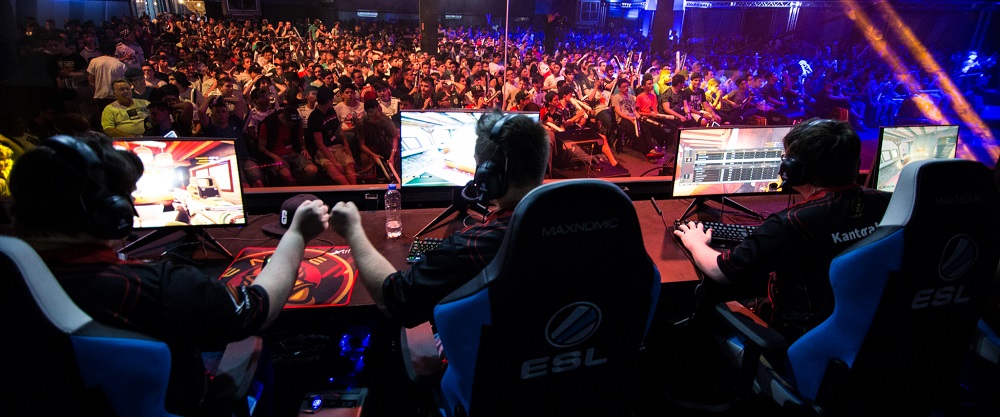
In terms of comparisons, E-Sports Players, Analysts and Youtubers often fall under . Although, even then, the gap in devotion between someone that falls under the “Hardcore Gamer” label and any of the aforementioned labels is immense, this is the same for the “Casual Gamer” label. Despite this assuming all Gamers fall under any given label is an irrational opinion.
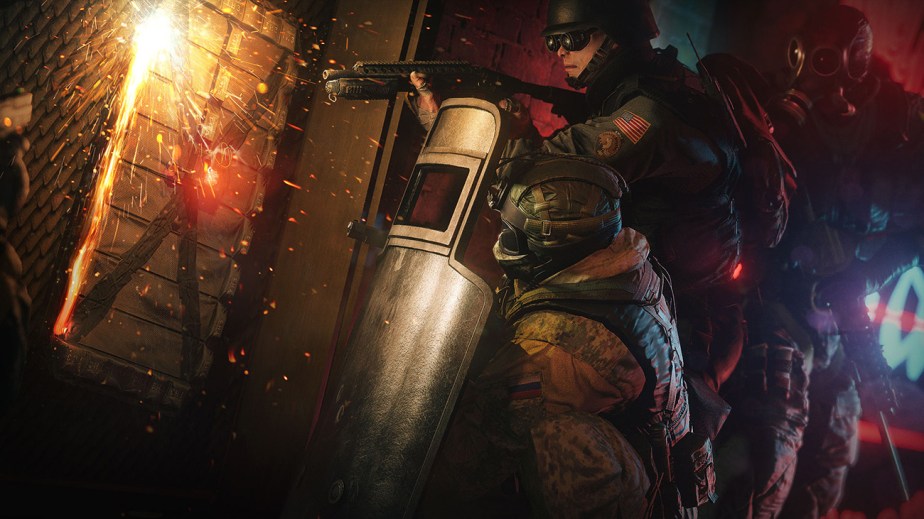
Live event for the Rainbow Six: Siege Pro League
The label “Gamers” is a broad one, and one that can belong to any individual. Be they Male or Female (or anything in between), Young or Old, play Alone or with Others, play a few minutes here and there or play for hours on end, use it to escape their normal lives or just for fun. I could go on and on about the different types of people who play games and their reasoning but I’ll stop it there
Every person has their reasoning to play games and even whether they classify themselves as a Gamer. Regardless of that is the fact that the term “Gamer” is important to both the players themselves and developers. While I find the term “Gamer” to be more socially used to describe someone’s interests and hobbies, the Gaming Industry as a whole needs to look at the sub-categories for their usage.
The Gaming Industry uses these labels as a form of Demographic to use for targeting purposes for their games. Looking at these sub-categories is important for not just marketing a game but also for making the game itself. They look at the characteristics of these sub-categories of “Gamers” to figure out how to make the game for that specific category.
Therefore, as stated, the term “Gamer” is useful in a way to identify people as a whole, but also broad enough to be inclusive to all. I myself find the term positive and a part of my own identity. My engagement with Games Culture as a whole is what makes me feel like I belong to this label. I take part in online forums, IRL events and, of course, playing games themselves for hours upon hours on end.
Candy Crush
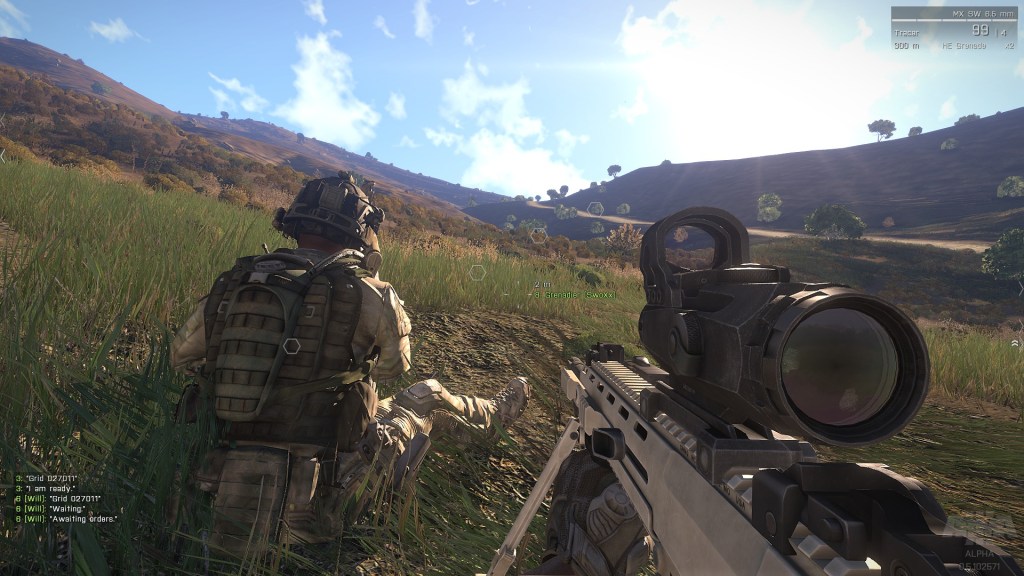
Arma 3
City Skylines
A trio of games that appeal to very different people but all come under the “Gamer” label
That’s it for this week! Sorry for the break, uni split up due to COVID-19 and moved to Online Delivery so that was a bit stressful, but we’re back on track now.
Thanks for reading! I’ll see you next week! – Nathan “Naff” Hibbert
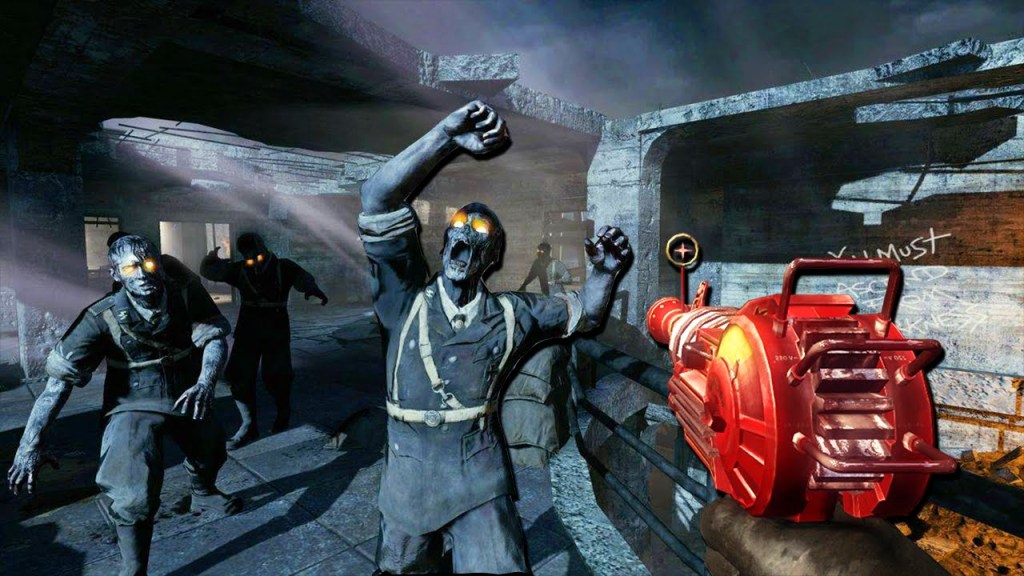
Call of Duty has been a staple of my gaming catalogue for almost as long as I can remember. I was always tuned into the Series itself but never managed to get myself a copy of a main series title until I picked up Call of Duty: Black Ops 2 for the PS3. Although, the first Call of Duty game I ever played was Call of Duty 4: Modern Warfare. My friends and I have always had a significant love for the “Zombies” mode that made it’s debut in Call of Duty: World at War.
Screenshot of a remastered version of Call of Duty: World at War‘s first Zombies Map “Nacht Der Untoten”.
The first Call of Duty (COD) game was titled Call of Duty in 2003, Developed by Infinity Ward and was originally only released on PC, but was eventually re-released on XBOX 360 and PS3 as Call of Duty: Classic. This marked the modest beginnings of what would soon become one of Gaming’s most influential Titles. With the following Main Series games backing up the franchise throughout the years:
Call of Duty (Original)
Call of Duty: Finest Hour
Call of Duty 2
Call of Duty 2: Big Red One
Call of Duty 3
Call of Duty 4: Modern Warfare
Call of Duty: World at War
Call of Duty: Modern Warfare 2
Call of Duty: Black Ops
Call of Duty Modern Warfare 3
Call of Duty: Black Ops II
Call of Duty: Ghosts
Call of Duty: Advanced Warfare
Call of Duty: Black Ops III
Call of Duty: Infinite Warfare
Call of Duty: WWII
Call of Duty: Black Ops 4
Call of Duty: Modern Warfare
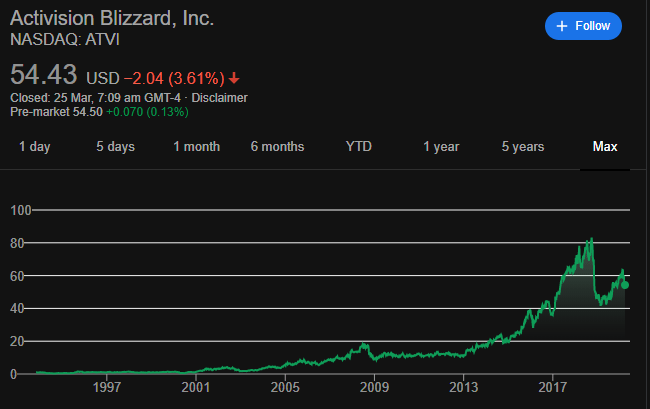
The Series itself is Produced by Activision and always has been a staple of their game roster. With gradual rise in Activision Stocks from the release of the original Call of Duty until the release of Call of Duty: Black Ops 4, easily the Series’ low point. This increase is easily one of the most impressive in Gaming history and truly shows the uptake in gaming that was happening in the late 2000s/early 2010s. As gaming transitioned to a less niche role in society, so did the companies that made them. At the start of 2003, Activision stocks were priced at roughly $1.68 USD, with prices sitting at roughly $80 USD at it’s peak.
Activision Stock Graph showing the increase in Stock Price since late 2003 and drop off in late 2018.
This increase showed that gaming was a very powerful tool in the economic sector, only helping aid the regrowth that was most likely pushed forward by the release of the Playstation 2 in 2000.
As I mentioned previously, the abundance of people playing video games was slowly increasing and Call of Duty titles were one of the main attractions to newer players. The games had fantastic gunplay and great social features which allowed players to connect and interact in ways never before seen. With the parallel growth of online video services gameplay videos skyrocketed, with one of the most famous genre for Call of Duty videos (at the time) being Trickshots.
Short Trickshot Montage, example of the content that was spawned from the Call of Duty communnity.
This widespread growth of gaming culture brought about the transition of gaming coming into a more common-place entertainment method. Once again, Call of Duty was at the forefront of this growth. As a kid, I remember almost everyone I was at school with would play Call of Duty and almost nothing else. People who would normally fit a more athletic stereotype, for instance, would find themselves playing games like Call of Duty . This is just one example of the immense growth the gaming industry found.
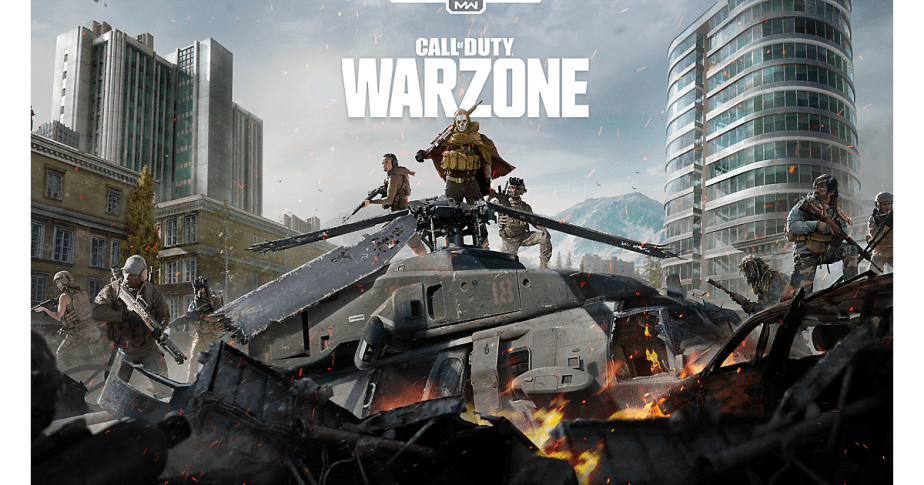
A free-to-play add-on for Call of Duty: Modern Warfare was recently released in the form of a Battle Royale known as; Call of Duty: Warzone. It has seen moderate success and has very solid gameplay from my experience and definitely throws it’s own spin on the very successful Battle Royale Genre.
I hope this has somehow shown you the significance and impact of the Call of Duty franchise in relation to Gaming History in recent years. The rise and decline of the series is one to tell for the ages and even without it, it’s impact on society itself will be forever known.
Thanks for reading this week! – Nathan “Naff” Hibbert
The world we live in is taking a turn for the weird and scary. With the constant threat of COVID-19, or Coronavirus, threatening the World’s very Social structure, almost everyone is being told to hunker down inside their homes and prepare for the long haul, I myself have had to take time away from my University Campus and attend classes at home for an unspecified amount of time due to the Virus. Most people just want to get away from all this widespread fear and panic, with whatever means available to them.
Funnily enough, a game that allows a person to leave their everyday (or not so everyday but more panic inducing) lives. Animal Crossing: New Horizons was released on the 20th of March 2020, in the height of the COVID-19 Pandemic, gifting the people who are suffering from these effects a way to escape the wave of fear that’s spreading across the Planet.
The game presents this as an opportunity from returning character and Loan Shark, Tom Nook. Tom has a package that allows a person to get away from their current life and start life a-new upon a deserted island. Building it from the ground up to a lively and community driven town.
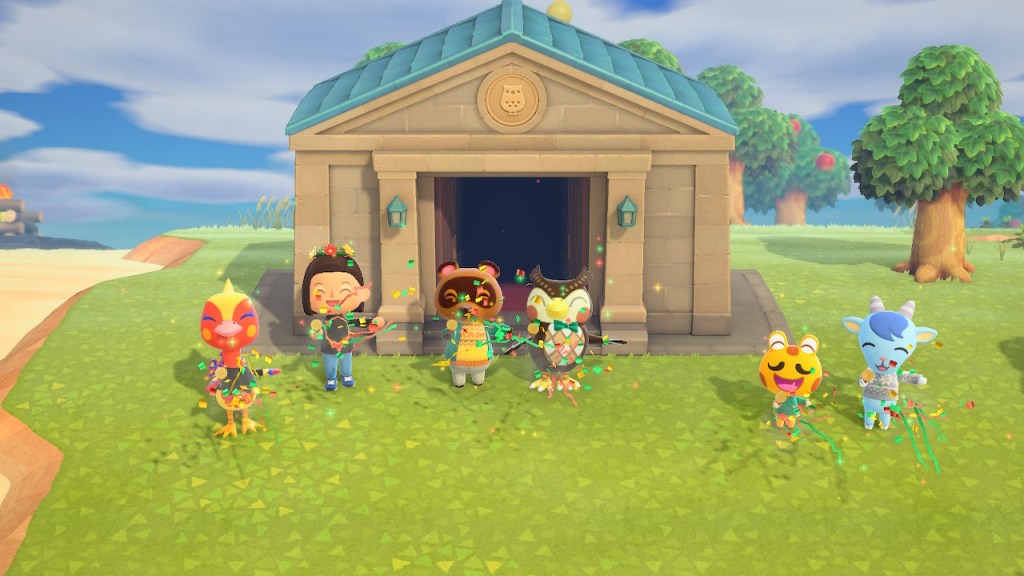
The members of my Island celebrating the opening of Blather’s New Museum
The player will find themselves doing various activities such as:
Fishing
Gardening
Catching Bugs
Chopping down trees (or not)
Building Houses and Property for various needs
Building Bridges
Mining Rocks
Flying to other deserted islands for resource gathering
Paying off Copious amounts of In-Game Debt (Thanks Tom Nook!)
And much, much more.
One more important activity that can be done in Animal Crossing: New Horizons, is that players can utilise online play to visit each other’s Islands. It allows players to check out what each other have done in their time on the Island as well as trade items and even sell items from their own island for (potentially) a higher price.
These mechanics and activities are all important to someone playing Animal Crossing: New Horizons in this day because it allows them to experience the things that they can’t do while stuck inside their houses. People can fish for exotic creatures (and not so exotic ones such as rocks) and can even catch tropical creepy crawlies, such as Scorpions and Tarantula Spiders.
The possibility that people can visit each other keeps us all connected during these trying times. Sure we have the internet and social media but there isn’t anything quite like gathering a bunch of friends to adventure across your Island of hard-ship. This is certainly something you can’t do in real life, especially with all the governmental crackdowns on gatherings.
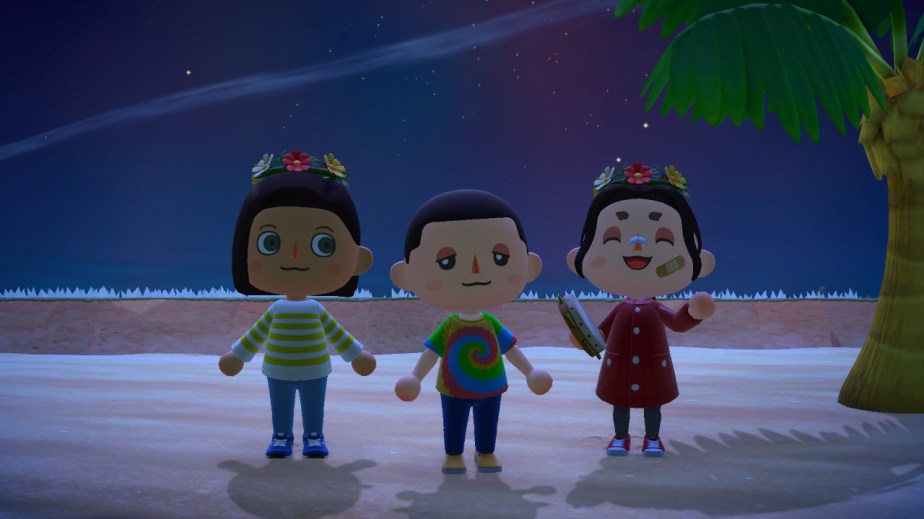
Myself and Two friends, enjoying our time at the Beach on my Island.
In this trying time, Animal Crossing has become our saving grace. Allowing us all to stay connected and somewhat productive in these trying times.
I’m sure we all look to Game reviews or criticisms when we’re thinking about picking up a new game, be that through official avenues such as Kotaku or IGN, or places like Steam User Reviews. Heck even asking someone at your local Games store. We all do it from time to time. I personally see these articles as Subjective rather than Objective, as a review/criticism is something that is suppose to tell others about an experience with a game itself as a whole. Criticism, on the other hand, is usually VERY Objective. This is because criticism is largely thought to not take into account a person’s experience with a game and only what the game has to offer should matter.
I disagree with that and I will tell you why.
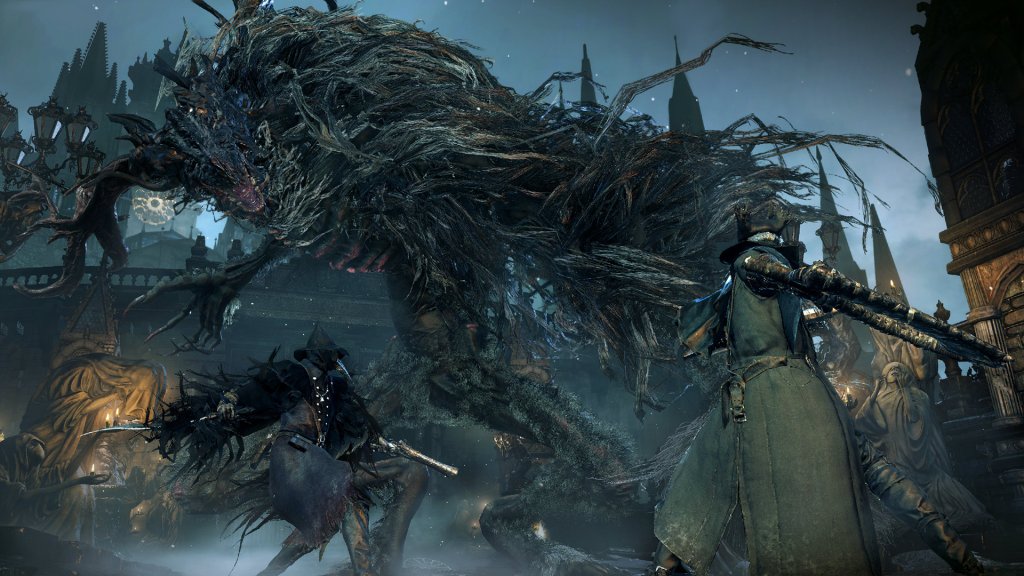
The Player Character (Right) fighting the Game’s first boss, Cleric Beast with an NPC Summon Eileen The Crow (Left)
Firstly we must talk about the most important thing that comes to gaming, or any media in general really, the player’s experience. The experiences that the player both brings to the game and those that the player has while inside the game.
Each person’s experience will wildly differ therefore each person’s experience will be different. This leads to reviews/criticism being severely individualized, which in my point of view is a good thing. Subjective reviews/criticism allow for players to understand a person’s mindset and their own comprehension of a game. Although this does mean that a certain article mightn’t conform to any given person, but this allows that the sheer abundance of reviews/criticisms that exist in this day and age will surely cater to someone’s viewpoint.
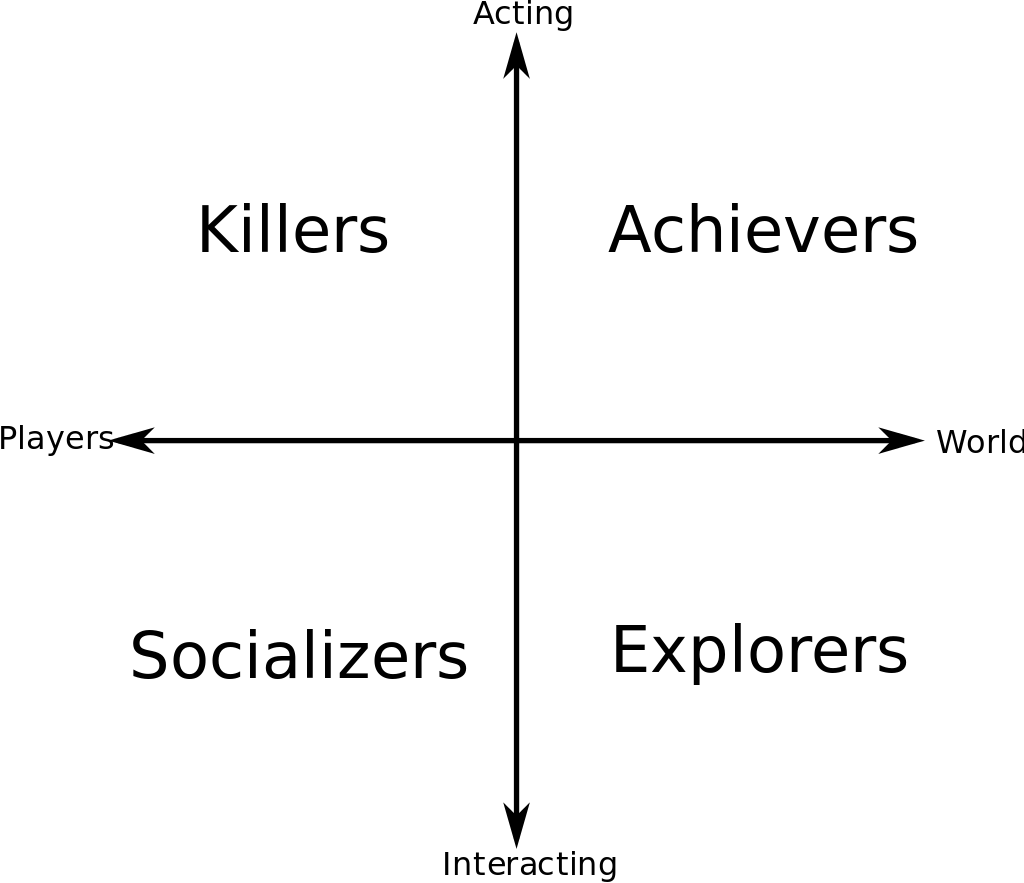
Going into more what subjectivity is, people have different life experiences and mindsets that affect their play experience and style. Any given person can fit into one or more of the following psychological categories:
Killers
Achievers
Explorers
Socializers
Killers are people who play games that look to cause mayhem and havoc among a given game. They’ll go through a server destroying their opponents through either legitimate or illegitimate means.
Achievers are the people that look to do everything and everything in a game. This goes from completing the achievements for the game, finishing all the side-quests or even just completing self-imposed challenges. They seek a challenge of any sort.
Explorers will go far and wide to see everything a game has to offer. See every nook and cranny of a game world, see every line of dialogue an NPC has to say, even understanding the finer details of the game’s mechanics themselves.
Socializers are the extroverts of gaming so to speak. They go into a game and look to communicate and make relationships with other players in the game more so than playing the game itself. This can be through in-game methods (e.g. Guilds or Friend lists) or fan communities (e.g. Subreddits or Facebook groups).
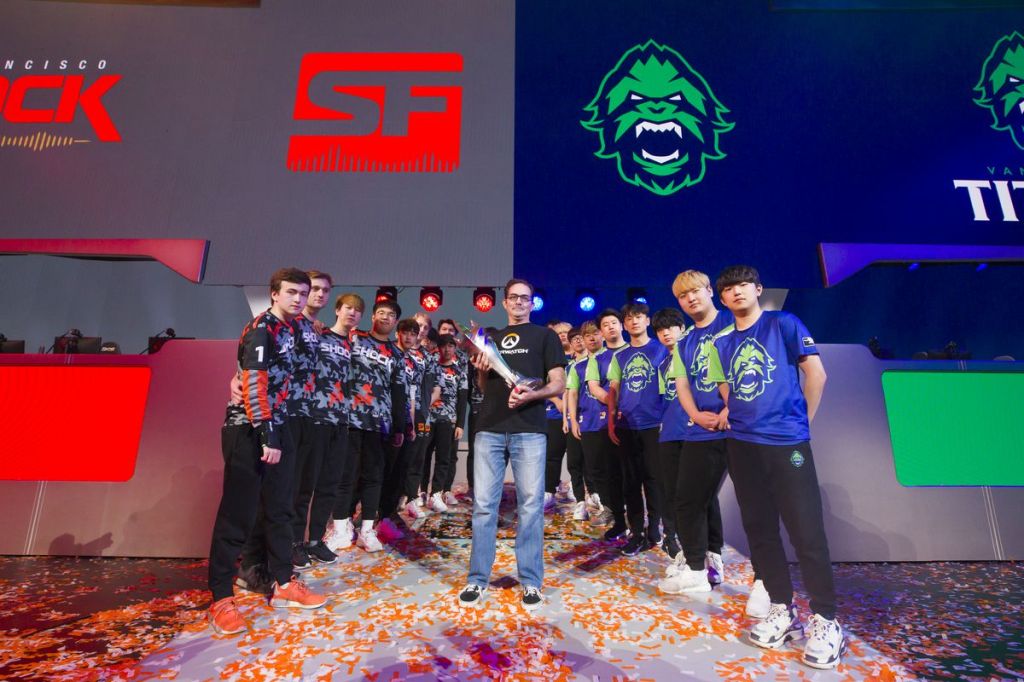
Image from the 2019 Overwatch League Finals between the San Francisco Shock and the Vancouver Titans. These players are an example of both Killers and Achievers.
The type of player alone will contribute to a given review/criticism if subjectivity is involved. A review/criticism from a player who is more of a killer while playing a game, is not necessarily going to engage a player that is more of an explorer.
But this is exactly why Subjectivity is needed in games. A person’s experience with a game is directly influenced by their play-style. This is important to a review/criticism as a person can really get a feel for what a game is.
With Objective reviews/criticism, the game is broken down to simply narrative, gameplay and visuals for the most part. This gives the reader a sense for what the game looks like and plays like to an extent. But NOT to the extent a Subjective review/criticism would do.
Take Rainbow Six: Siege for example, I have played an immense amount since early 2017, just before the release of it’s Velvet Shell expansion. I currently have around 850 hours played on Steam and love it to death, sure I have my gripes with it but it is truly a fantastic game.
However, if I were to give a review on it Objectively I couldn’t truly show what the game feels like to play. I would mention that the gun play and mechanics are spectacular, the feel of almost every gun is great and the ability to out skill an opponent (or out luck an opponent) and kill them with a ‘one-shot headshot’ is super satisfying each and every time. The breaching and rappelling mechanics were new to me and definitely took some getting used to but I love the uniqueness of it and the amount of versatility added to the game utilizing these mechanics.
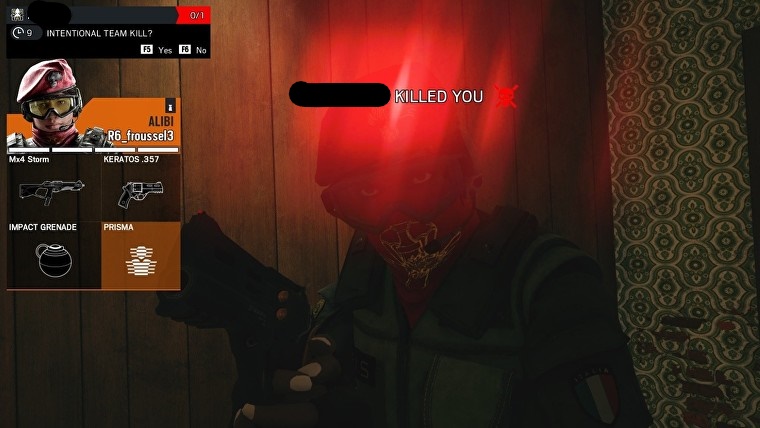
If I were to give a Subjective review though, I would mention that dominating people is the single most satisfying bit in the game. Somehow clutching a 1-5 is a moment of pure hype and excitement among the whole team (be these people you know or not). But the game’s players can lean into the Killer category a lot. You see, R6: Siege has a friendly-fire mechanic, this means that teammates can damage each other. This leads to a lot of toxicity if a person gets annoyed with another. Over the time I’ve played I couldn’t count the amount of times I’ve been team-killed for seemingly no reason on both my hands and feet. It certainly ruins the experience sometimes.
A Team killing scenario with a box asking if it was intentional. If the player reports it as intentional the killer receives a penalty.
That is the difference between the two types of reviews/criticism. albeit to a smaller extent. Someone could read my Subjective review and be enticed to play the game more so than they otherwise would be, the possibility to just murder teammates that are annoying definitely talks to some people. In that same vein, it might very well turn some people off the game entirely.
This is why Subjective reviews/criticism are needed. They give a reader a more comprehensive feel for what the game is like to play and therefore can make a more informed decision .
Another reason we need Subjectivity in game’s reviews/criticism is because it gives a voice to the people that need it. In an Objective look at a game it doesn’t matter who you are, you are just a piece of meat tapping keys and talking about a game. Whereas a Subjective look brings your personality into account and really brings forward who YOU are. To relate to another post of mine (Diversity of LGBTQIA+ Characters in Video Games), I for one would love to point out the sexual orientation of the characters I encountered on my journey throughout a game. This mightn’t matter to some people but it does to me and a lot of other people.
All in all, I believe we need Subjectivity because it shows the game for what it truly is. An experience for the player. The player plays the game for the experience, be that as a Killer, Achiever, Explorer, Socializer or a mixture of the lot.
The player’s experience is moulded by their entire being, who they are, what they find important and how they play. Subjective criticism and reviews show this in a brighter light than an Objective view could ever.
Hello again! For this week’s first post I will be taking a look at a fellow blogger and colleague Mahalah or MoshiBoi (here’s a link to their Blog) and their response to an article titled “Revisiting Animal Crossing: New Leaf was a Mistake” by Kotaku writer ‘Narelle Ho Sang‘ , the original article can be found here.
I myself have never played an Animal Crossing game (a sin I know) but I have played a similar title in Stardew Valley and I am certainly looking forward to Animal Crossing: New Horizons‘ release in the coming weeks. I mention this as I need to state that I am not familiar with the game itself an it’s intricacies.
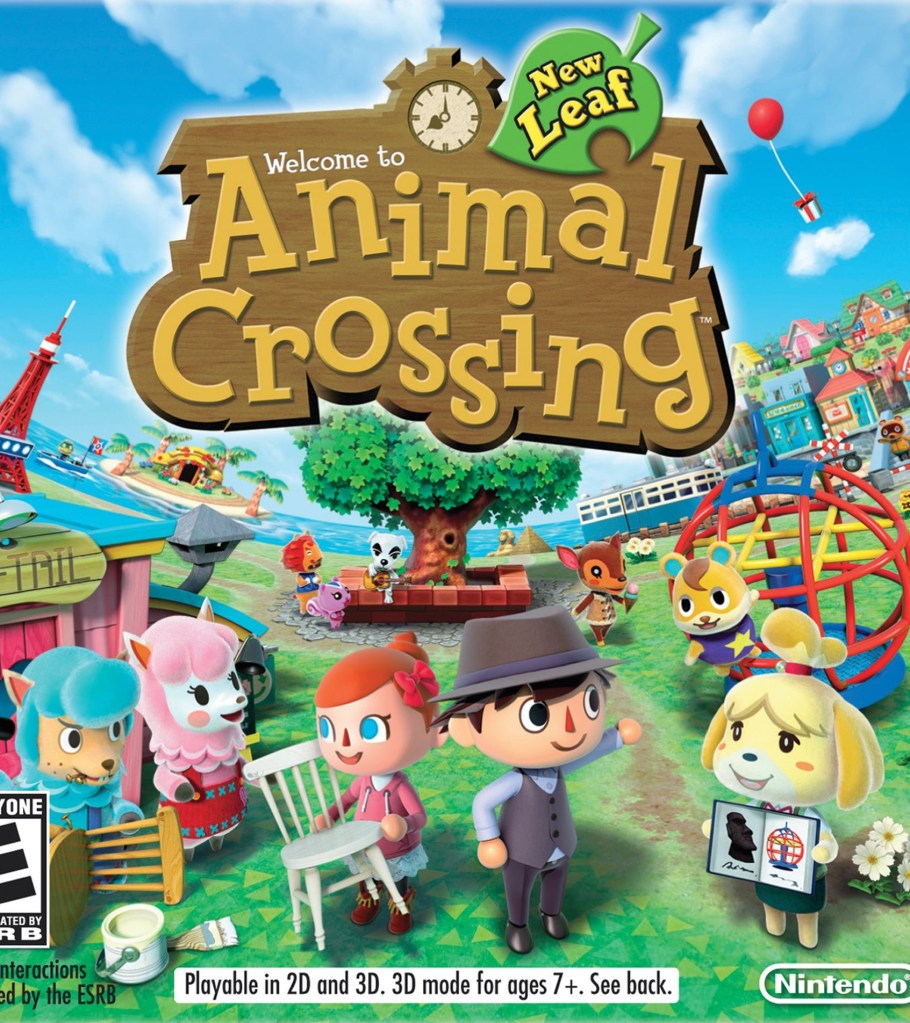
Animal Crossing: New Leaf Cover Art
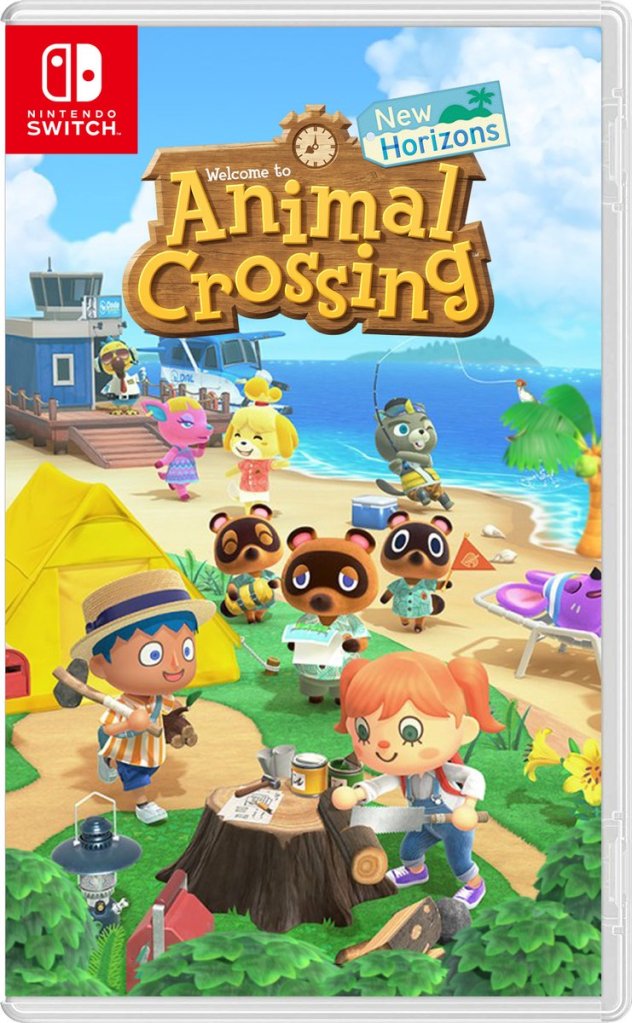
Animal Crossing: New Horizons Cover Art
During my read of the MoshiBoi’s blog post, the title of the original article was quoted being about why Animal Crossing: New Leaf was a mistake. So my opinion on reading the blog was shaped by this misunderstanding and so I myself felt the article was a waste of time. I felt like the article more heavily talked about the problems with why returning to the game was a hard time due to NPC interactions heavily berating the player for leaving their beloved town.
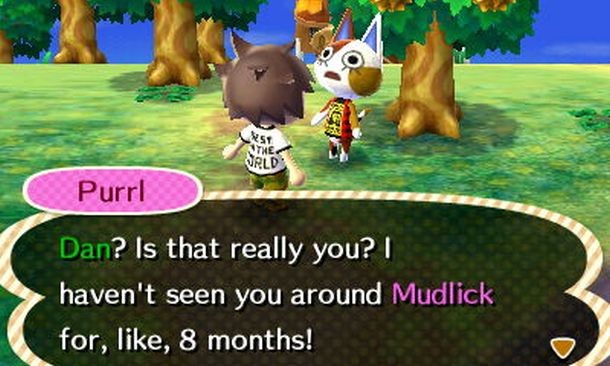
After reading the original article for myself however, I now see that it is a talk about the problems with revisiting the game itself after putting it down for a long period of time. As Narelle stated “The hours and calendar days pass in real-time. The seasons change…”, the whole time they weren’t playing the Town continued to grow and NPCs grew tired of missing the player, who is the Mayor in this game.
Animal Crossing: New Leaf NPC – Purrl stating how long the player has put the game down
Going back to Moshiboi’s post, they go on to mention that the writer was immersed and clearly had fun while playing the game originally. While some of their planning and decorative decisions might be hard to look at, they at the time still enjoyed the game and did what they wanted to.
Both Blog and Article mention NPCs putting the player down for not playing the game for a while, Narelle stating “Each (NPC) laying on the guilt with emotional surgical preciseness—cutting me deep.” This goes to show the player’s attachment to these characters and the town they had made. This is the reason the NPCs talk in this way, to make the player feel bad and to get them to come back for a bit longer. Moshiboi, however, paints this as a severe and inappropriate “Guilt Trip” stating “I think getting guilt tripped by an NPC for not playing the game in a while is a bit much”. This is a fair statement as honestly these NPCs don’t know about the player’s attachment to the game or do they know about real-life events that might prevent play.
Moshiboi goes to say that since the game is mostly targeted at Children that a child hearing these statements from NPCs would make them want to come back even more so. This is because of the blurred line between Reality and Fiction that children are unable to discern.
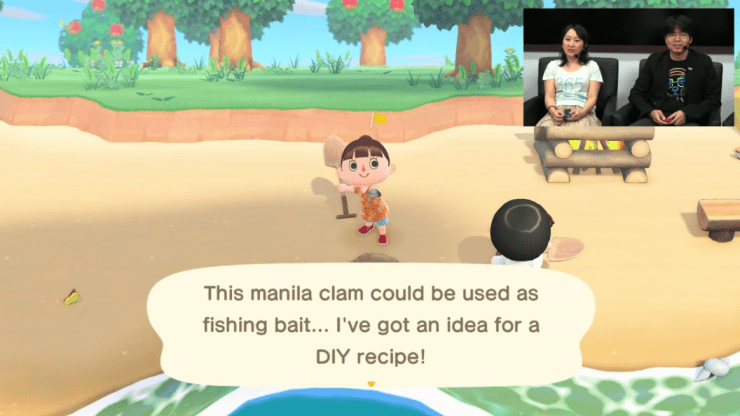
Screenshot of gameplay of Animal Crossing: New Horizons from the E3 2019 Nintendo Treehouse
My take away from both the Article and Blog is that you can look back at your past self’s decisions and either love it or hate it, but you can’t neglect the fact that people change. As both authors stated, they have spent hours upon hours making their town into their own vision. Placing things where they want and doing what they want at any given time, this lends itself to the notion that while immersed in such a free game they enter the ‘Magic Circle’. This term refers to the zone a player can fall into when deeply immersed in a game’s world. It seems both of these players did at one point or another. Simply put, originally, the players loved what they were doing.
Another thing is that people’s style and tastes change over time. What was appealing to you 5 years ago might not necessarily appeal to you now. As someone who played soccer for 16 years of his life I can tell you that now having not played for 2 years now I have little to no interest in the sport. People Change.
People change but they had fun originally!
That’s it for this post, again you can find the original article and Moshiboi’s response here:
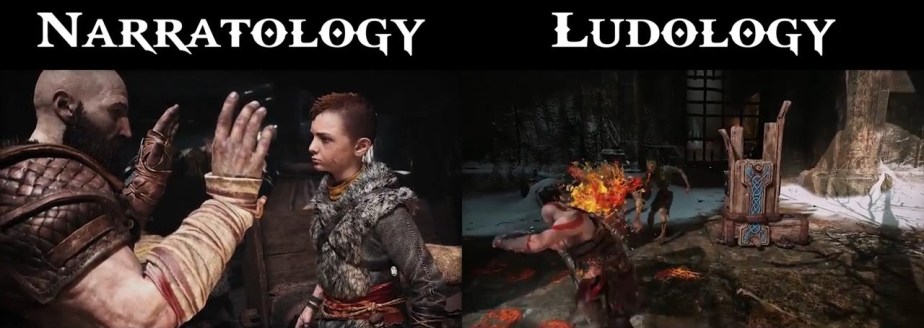
A second post for this week? Crazy right? After a look at the Narrative in relation to player interaction in Dark Souls that can be found here, I will be looking at Ludonarrative Dissonance. Ludonarrative Dissonance refers to the conflicting approach that can be found in Video Games between Gameplay choices (ludic) and Narrative choices. This term was first coined in a blog post by Clint Hocking called Ludonarrative Dissonance in Bioshock. Feel free to give it a read before reading this post as I will be referencing it heavily.
I myself had always been under the acceptance that a Game is a Game, meant to be enjoyed through gameplay and that it’s narrative can come second. Even when these two features of the game clashed I never really thought about it. Having read Hocking’s post I now seem to understand the importance of the term ‘Ludonarrative Dissonance’.
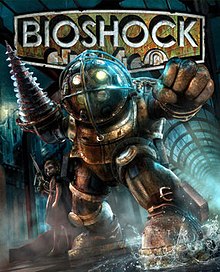
Cover art for Bioware’s Bioshock
Looking strictly at Bioshock with relation to Hocking’s post for starters. I have only played through about half of the original Bioshock so this might seem biased to the critique. The game seems to “suffer from a powerful dissonance between what it is about as a game, and what it is about as a story”. It does this by “throwing the narrative and ludic elements of the work into opposition”.
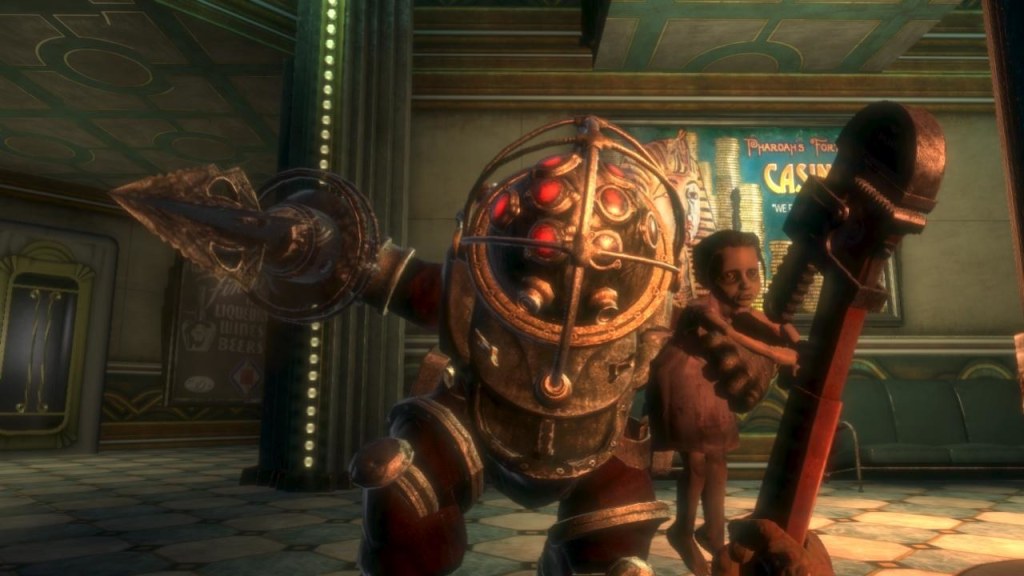
Bioshock as a whole is an examination and criticism of ‘Randian Objectivism’. This refers to the practice that whatever helps you get ahead is morally the correct choice. During gameplay the player is given the choice to either save or harvest characters called ‘Little Sisters’. These ‘Little Sisters’ are used to gain upgrade points in the form of Adam, which is used to upgrade your unnatural powers. This enforces the Randian way of thinking as harvesting the ‘Little Sisters’ rewards the player with more Adam than saving them would.
A ‘Little Sister’ in the arms of her “protector” a ‘Big Daddy’
Narratively, the player is given no such choice. You MUST help someone, this being Atlas, to progress through the game. This directly opposes the Randian way of thinking, since the gameplay shows that you can have the choice to not help anyone and do what is best for you, the player is more aligned with the game’s antagonist ‘Andrew Ryan’. So why should we oppose him if our philosophical beliefs align?
The answer is: Because the narrative says so.
The way I would and did go, and most others would go, is to accept that it’s a game and since the mechanics are great they’ll overlook the break that is the narrative forcing them to do something out of character. Hocking suggests that this is a mocking of the player for accepting the weakness of the medium.
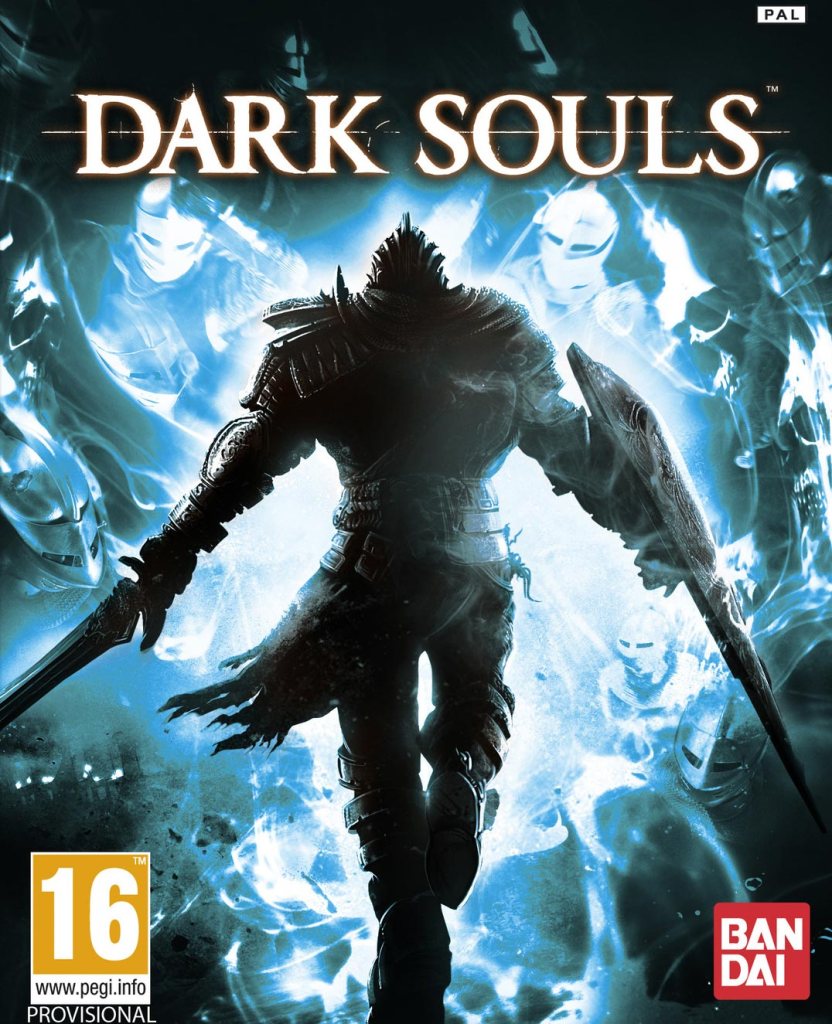
As I stated earlier, I personally don’t mind when these two features of Video Games don’t align properly. If I wanted a compelling story without the fun of going through it myself I would watch a movie. Or if I wanted to play through a game while focusing on gameplay alone I’d play Tetris or Dark Souls (an interesting comparison but anyway).
Dark Souls Cover Art
Tetris 99 Cover Art
Regardless of my feelings towards this blog post and it’s contents. I will say that this kind of term, that being ‘Ludonarrative Dissonance’, is important for games criticism. Being able to point out the shortcomings of a highly narrative driven game such as Bioshock is important. Bioshock happens to be a loose fit I would say as both elements, Narrative and Gameplay, are fantastic from my experience and you can enjoy it for both while not being unimmersed while playing. Being able to describe the difference in Gameplay and Narrative in a single statement is very important as it lets whoever is critiquing a game get the point across easily without threat of confusion.
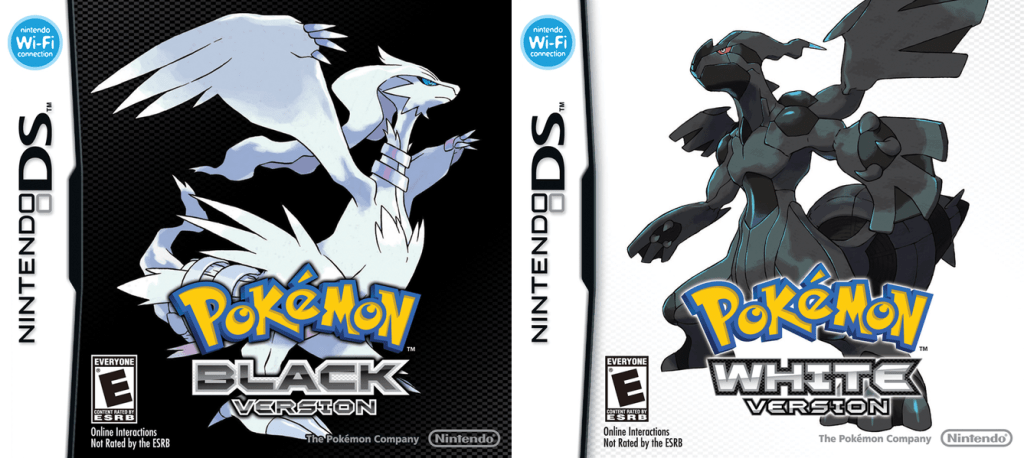
I can say that I have run into this Ludonarrative Dissonance before. In Pokemon of all places. In Pokemon Black and White, the first instalments of the Fifth Generation Pokemon games, presented a narrative that greatly opposed the core gameplay of the series.
Cover art for both Pokemon Black and White for the Nintendo DS
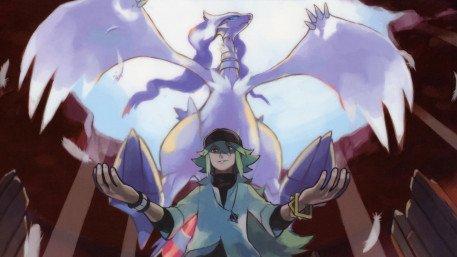
The Player is presented a philosophical question. The question being “Is training and battling Pokemon in the way we have morally right?”. This is posed to the player by the character ‘N’, a mysterious person working with the game’s villainous team, ‘Team Plasma’. For most of the game N and Team Plasma suggest to the player and other characters about the moral correctness of battling Pokemon. With questions like; “What if Pokemon don’t want to battle?”, “What if Pokemon don’t want to come with you?” and “Would you feel comfortable being sucked into a ball and live there for most of your life?” it was hard not to think about these questions and what it relates to in real life. What if we were chicken fighting instead? Or Dog racing even? It definitely challenges the players moral compass.
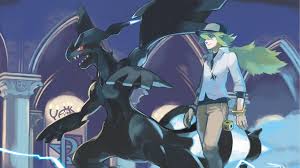
Official Artwork for N with a Legendary Pokemon Reshiram.
Official Artwork for N with a Legendary Pokemon Zekrom.
In relation to that, the game does NOT offer the player the choice to just lay down their Pokeballs and finish up. To progress through the story the player must continue to utilise their Pokemon and defeat other Pokemon through battle. Although the story does end up showing that Team Plasma were working in their own interests, not for the Pokemon’s.
It might be a bit of a loose comparison but I found it interesting to use the term Ludonarrative Dissonance in relation to a Pokemon game of all things. I wouldn’t normally say Pokemon Games are huge narrative driven games but Black and White certainly made me question some things.
To sum up, the term Ludonarrative Dissonance is an interesting and important one when it comes to Video Games critique and journalism. As Hocking mentions in his post “BioShock is not our Citizen Kane. But it does…show us how close we are to achieving that milestone” and I think that’s an interesting statement. In recent years the matching of Gameplay and Narrative has certainly begun to come more clear with less of this Ludonarrative Dissonance and a much more clear focus of themes and player choice.
That’s it for me this week! I hope you enjoyed reading and I’ll see you next week!
In today’s post I will be taking a look at the story of my favourite game of all time, Dark Souls. This game is often highlighted for it’s phenomenal gameplay mechanics, but what often goes unnoticed is it’s also phenomenal story. But first, I will touch on these gameplay mechanics:
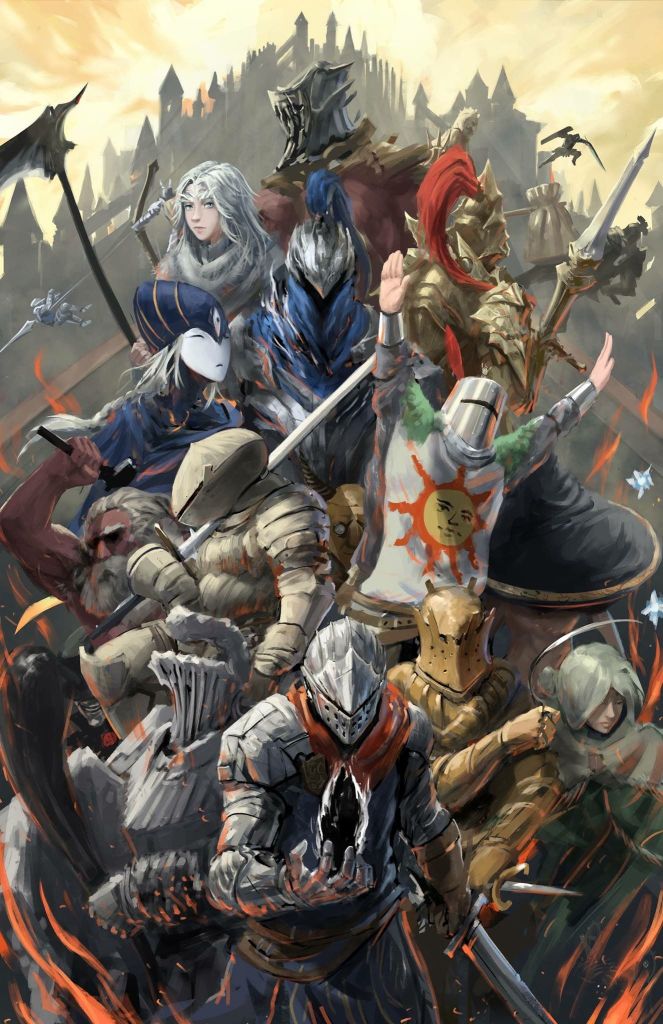
An Illustration of Dark Souls characters by Nolan on Etsy
The Original Dark Souls Cover Art
What does the Player do?
During the duration of Dark Souls the player ventures through a dark and dense Medieval landscape known as Lordran, collecting treasures and slaying both humanoid and monstrous enemies. They do this using a variety of tactics, from one-handed and two-handed weapons (such as Straight Swords and Great Hammers), to powerful magic (such as Sorcery and Pyromancy) that either do direct damage to an enemy or buffs (or sometimes hurts) the player, and even utilising shields to block damage altogether.
Of course, while fighting these ferocious enemies the player must do so while taking minimal damage. If an attack is unblockable or not worth blocking with a shield another mechanic is usable. This introduces us to the roll mechanic. By pressing the appropriate button the player will cause their character to roll, this can be used to avoid attacks due to the animation of the roll having what is called “i-frames” or invincibility frames. This allows the player to avoid damage and move into more advantageous positions, either for getting a critical backstab for massive damage or moving into more advantageous position.
While dodging damage might seem easy after that description, it really isn’t takes damage and must restore it by either using an Estus Flask, which is an item collected by the player at the very start of the game BUT has finite uses, or by resting at any of the far and few between Bonfires. Using an Estus Flask will put the player at risk of being hurt further if not timed correctly. Bonfires however allow the player to heal and level up, as well as store any excess items they’re holding and even repair weapons and armour. It does come with a massive downside though, it brings back any enemy the player may have killed already. This does have a limit though, it will NOT bring back Unique or Boss enemies. Players will also respawn at their last used Bonfire before death.
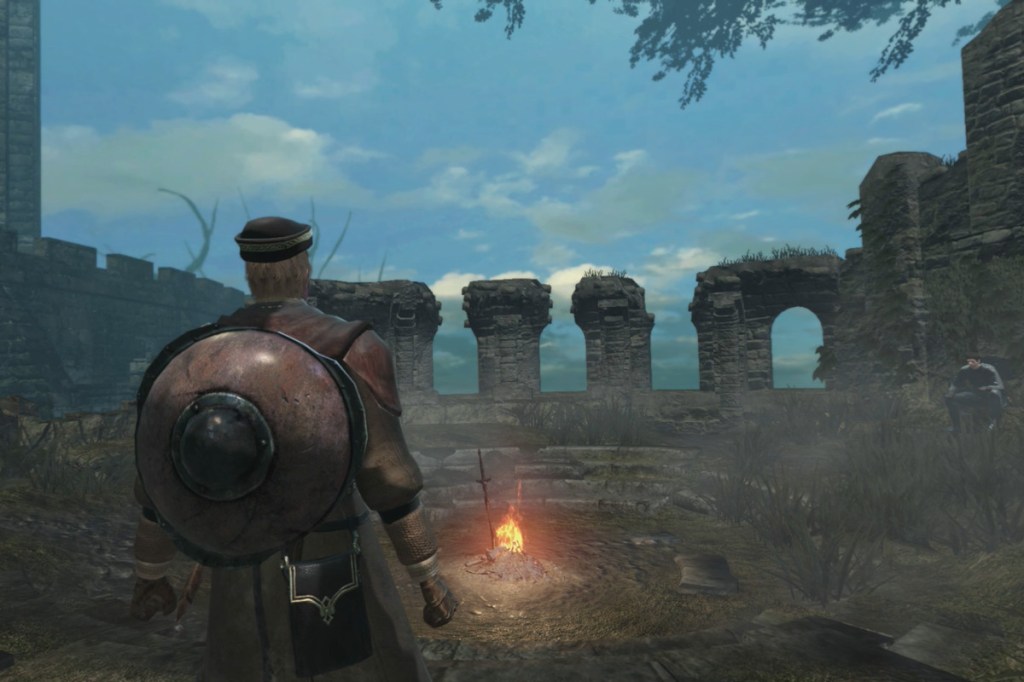
The Safety of Firelink Shrine, Dark Soul’s main hub
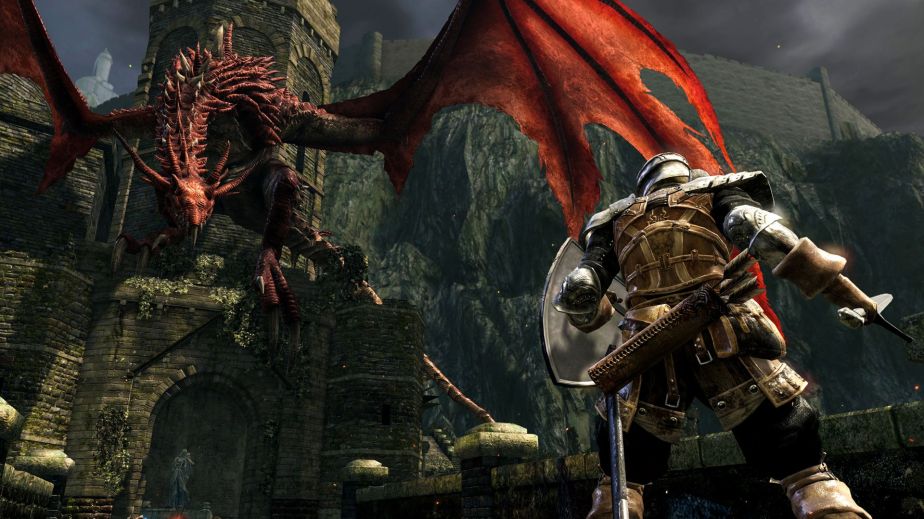
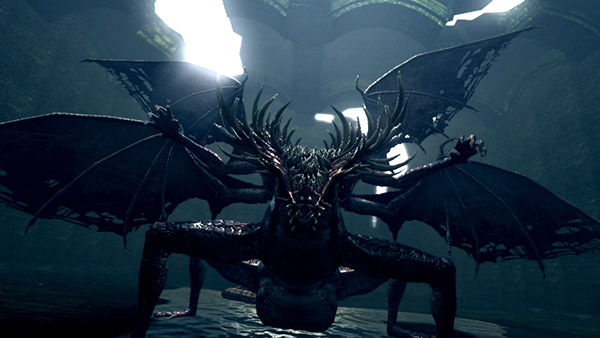
One of the more horrific bosses in Dark Souls, Gaping Dragon
Can these Actions be presented as a Story?
The actions of the player can certainly be presented as a story, any boss the player may encounter has a reason to it, the player is driven to press on and finds it necessary to defeat any given enemy. The tale of their fight is almost always a legendary one, from finally defeating the tough boss through trial and error to somehow defeating a boss most find “hard” on their first try. Everyone has a story to tell of their first time in Dark Souls.
A Timeline of Dark Soul’s Events
The game itself does have a very loose narrative, not told by conventional means. I will here list a timeline of events and since a lot of the game can be taken in any order I will list my personal experience.
The Player Character is shown locked away in an Undead Asylum, left to Hollow and Rot. Until a key to their cell is dropped in by an NPC known as Oscar of Astora.
The Player is then tasked with escaping the Asylum and after finding their first Bonfire and receiving the Estus Flask from Oscar, who is now on Death’s Door. find themselves standing in front of the first boss. The Asylum Demon.
After defeating the Asylum Demon they are whisked away by a large Black Crow and taken to the game’s hub, Firelink Shrine
By interacting with an NPC in the area known as “Crestfallen Warrior”, the player finds that there is something called “The Chosen Undead” and this Undead must ring the “Bell of Awakening” located above Firelink Shrine to eventually Link the First Flame and gain the prevail of the Gods.
The Player then heads upwards, away from the safety of Firelink Shrine towards the Undead Burg, a town and heads towards the first bell.
After defeating the Bell’s Guardians, The Bell Gargoyles, the player interacts with the Bell and rings their first bell. Interestingly enough players in other game can hear the bell ringing when another player does so.
Upon heading back to Firelink Shrine the player will find a large snake-like creature jutting out of the ground. This is a new NPC known as “Kingseeker Frampt”. Frampt goes on to tell you that there is not 1, but 2 “Bell of Awakening” and that he will assist you in any way he can.
The player is then tasked with going deep below the Undead Burg and even Firelink to a place called Blighttown. They reach this by beating 2 bosses, these being The Capra Demon and The Gaping Dragon.
In Blighttown they find the Second Bell, protecting by a half Spider, half Woman monstrosity called “Queelag”. After her defeat the Player safely rings the second “Bell of Awakening”
While speaking with Frampt the player finds that they must ascend to the city of the Gods called “Anor Londo” where they will meet Gwynevere, Princess of Sunlight.
After ascending “Sen’s Fortress”, a death trap of moving obstacles and Giants, and defeating the boss defending the path to “Anor Londo” called “The Iron Giant”, the player is lifted up into the sunlight filled city of “Anor Londo”
Upon arriving, the player meets a new character called the “Darkmoon Knightess” who describes the horrendous pair defending Gwynevere, “Ornstein and Smough”.
After traversing over precarious walkways and castle architecture, the player finally confronts “Ornstein and Smough”.
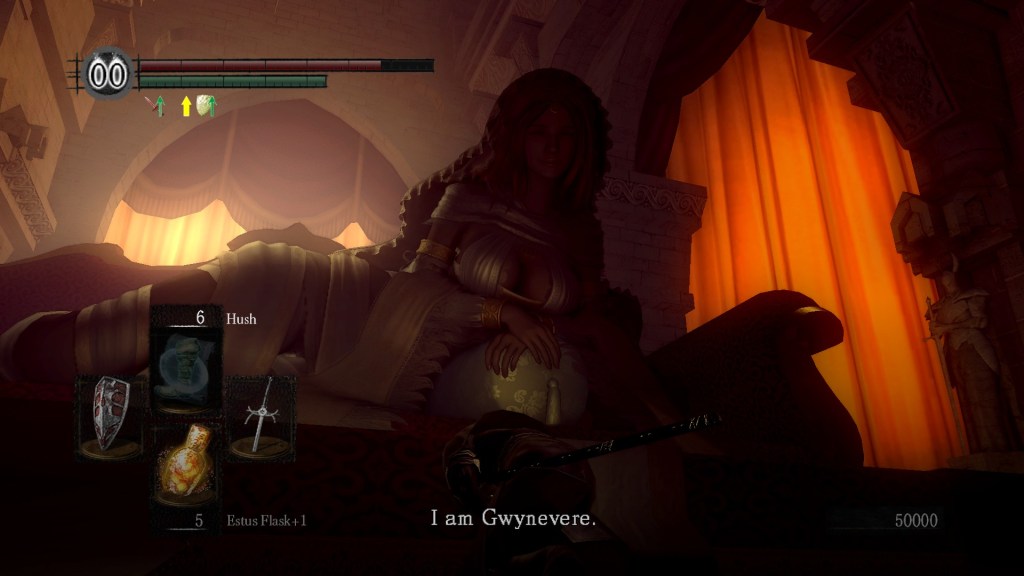
A tough victory is awarded to the player and they meet Gwynevere, who tells them that they must find the 4 Lord Souls to appease the First Flame. These Lord Souls take form of part of the Sun God Gwyn’s Soul that he bestowed upon people of importance during his reign. The player is also gifted the Lordvessel, an item to hold the Lord Souls and open the way to link the fire. This must be placed at Firelink Altar, deep below Firelink Shrine to open the way to the Lord Soul(s).
The Player Character, talking with The Princess of Sunlight, Gwynevere.
The player then forges ahead into the Grand Archives to defeat “Seath the Scaleless” and collect the first Lord Soul, after they promptly die to an invincible “Seath” in their first encounter, and push on into the Crystal Caves to face “Seath” properly.
After the player then takes on “Gravelord Nito” to collect their second Lord Soul, after descending even further than Blighttown below Firelink Shrine to the Catacombs to defeat “Pinwheel” and then onto Tomb of Giants where they will find “Nito”
Thirdly, the player must take on the “Bed of Chaos” deep within the ruins of Izalith, hidden even further down than the Tomb of Giants. After defeating “Firesage Demon” and “Demon Centipede” they are finally able to face the dreaded “Bed of Chaos”
Fourth, and finally, the player must face the “Four Kings”, to do this they must venture into the sunken city of New Londo. After draining it they find a path deep into a place called The Abyss, where the player cannot survive. They must find a ring that allows them to walk in the Abyss. They find this ring guarded by a large sword wielding boss called “Sif”, after this fact they can defeat the “Four Kings” and collect their final piece of the Lord Soul
Finally the player will venture down to Firelink Altar to place the Lord Souls in the Lordvessel and head into the Kiln of the First Flame.
The player finds the game’s final boss, “Gwyn, Lord of Cinder” deep inside the kiln and proceeds to fight him.
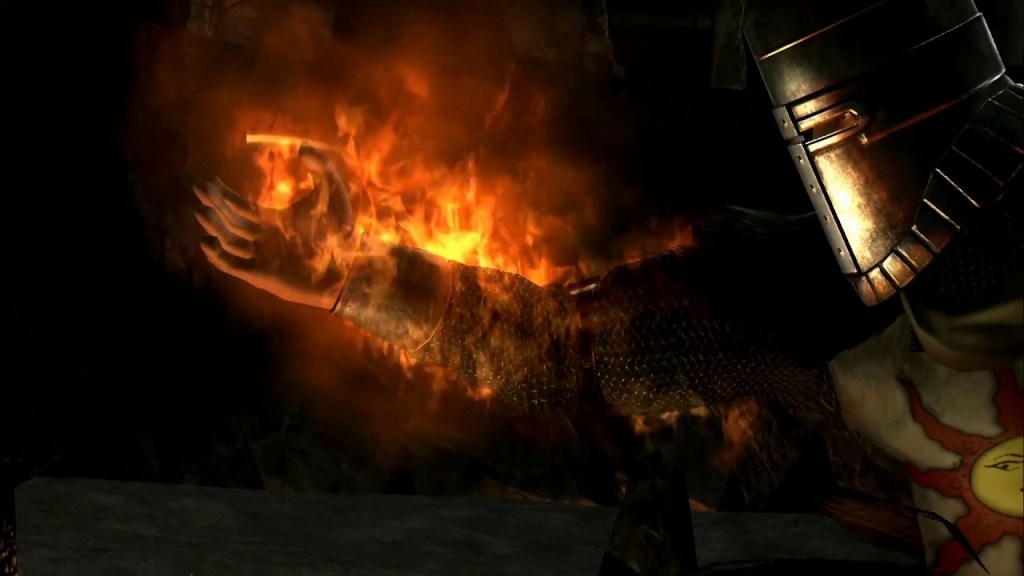
After his defeat the player can interact with the central Bonfire to Link the First Flame and finish Dark Souls.
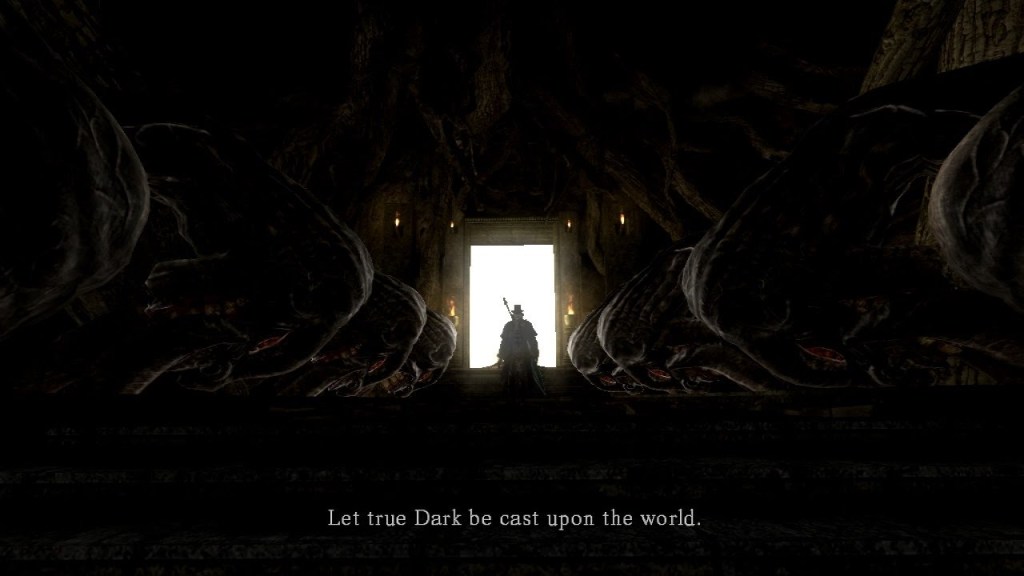
The Player Character, choosing to Link the First Flame.
Which are the most significant events in the story?
Now, I will specify that these dot points were from my first play-through of Dark Souls and is specifically vague as that is how the game shows it. The significant events through this story are certainly the ringing of the “Bells of Awakening”, ascending to “Anor Londo”, defeating and collecting the four Lord Souls, and finally defeating Gwyn and linking the first flame (or letting it fade for that matter). For each of these significant events I will now list what the player does to cause them, whether the player does it themselves or is it presented non-interactively.
To ring the “Bells of Awakening” the player must traverse through the game’s worlds and reach the physical locations themselves and then defeat the Boss guarding it. The player themselves does indeed ring the bell themselves by walking up to the bell and interacting with it. If the game had just rung it automatically for defeating the boss it would not be quite as impactful as it takes the player out of the immersion of having just beaten such a powerful enemy to reach this feat.
To ascend to “Anor Londo”, once again the player must traverse through an area, a very dangerous one at that, and eventually defeat a boss to be pulled up to the city. The player themselves doesn’t really do this themselves as they interact with a literal ring on the ground which causes a cutscene to play. In this cutscene the player character is shown being pulled up and over a large wall by flying demons. This doesn’t deny the brilliance of ascending the the City of the God’s for the first time though, it truly is a glorious sight.
Collecting the Lord Souls is very much like the last two points, but on a much more grand scale. Beating bosses and harvesting their souls to advance is very much a non-interactive event, each Lord Soul is presented directly to the player as a reward for defeating the 4 Bosses possessing the Lord Souls.
Finally, defeating Gwyn, Lord of Cinder and linking the first flame is much like the past 3 events. After defeating Gwyn the player can interact with the First Flame OR walk out of the arena. Interacting with the First Flame will show a cutscene of the player doing so. This is very much an interactive experience as the player can decide the outcome of the game itself.
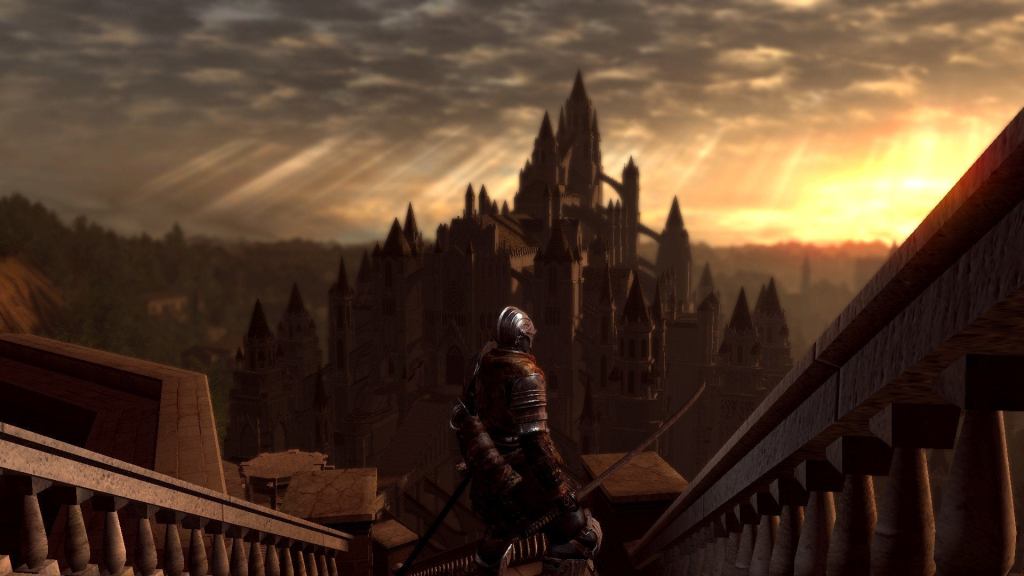
Anor Londo, City of the Gods, as the player sees it upon their first arrival.
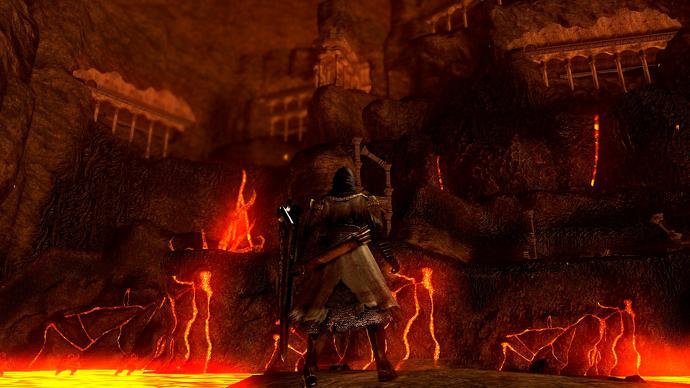
The Player looking up at the landscape of the Demon Ruins from the Lava filled base.
What is the Player’s Role in the Story?
Our timeline shows that the story of Dark Souls itself is quite literally centred around the player character, “The Chosen Undead”. Each event, major or minor, in the game’s story is influenced by the character. The game itself sees these events as nothing but hurdles, a means to an end, challenges that the player must overcome to see the end. The story itself is very vague and most of the exposition takes place through world building and back-stories shown through item descriptions. The game itself gives the player next to no rhyme or reason to any of this.
The player takes direct control of these events, regardless of if they know why they are there or not. Regardless of that they will ALWAYS have a story to tell after the fact. Meaning that the story itself is mostly about the player’s experience with the game Each decision, or lack there of, influences the story that a player will tell. Different story endings require different things to be completed during the game and so each play-through will have different endings, major points and experiences via the player alone.
A screenshot of one of the endings of Dark Souls.
Is this a STORY-DRIVEN game, or a game that HAS A STORY?
Dark Souls tells the story of a dark and bleak world, where all looks lost to humanity. The world is sinking into chaos, in some parts literally, and nobody knows what to do.
Throughout the game the player will tackle these areas, bosses and characters without not really knowing why. The draw of Dark Souls is that it is deep in terms of character Builds and challenging in combat.
That being said, Dark Souls is most certainly a game that has a story. The focus is the gameplay elements, and while the story and lore is phenomenal, it is NOT the focal point of the experience.
The game is top tier without knowing the details of any given event. Knowing these details however gives the player a deeper appreciation for the characters and areas they encounter. I could give a multitude of examples but I won’t. I’ll leave them for you to find if you’re interested.
On that note, the Youtube Channel VaatiVidya, is a fantastic source of lore and story explanations for Dark Souls (as well as other FromSoftware titles e.g. Bloodborne and Sekiro). Below is a video from his ‘Prepare to Cry’ series, which focuses on the tragic back-stories of the game’s beloved bosses and NPCs. This one in particular is about the infamous, Artorias the Abysswalker.
That’s it for this post, there will be another this week, tackling the topic of Ludonarrative Dissonance (the concept of story and gameplay matching) in Video Games.










 Naff's Gaming Blog