Many Video Games set out to achieve something, be that to tell a story, show a different perspective OR, in this particular case, change a person’s views on a particular topic. This week, I am talking about an article by Gina Roussos on Psychology Today from back in 2015 (found here). It talks about how a piece of media can actually end up doing changing a person’s mind to think the exact OPPOSITE of what was intended.
The focus of the article is an online game intended to change a person’s thoughts on people in poverty. The game is called ‘Spent’ and tries to put the player into the shoes of a person below the poverty line, it intends to show the player the difficult decisions one in such a situation faces on a day to day basis. It does this while challenging the player to make it through a month (30 Days), starting off with only $1000. If you’re interested you can find it online here: http://playspent.org/
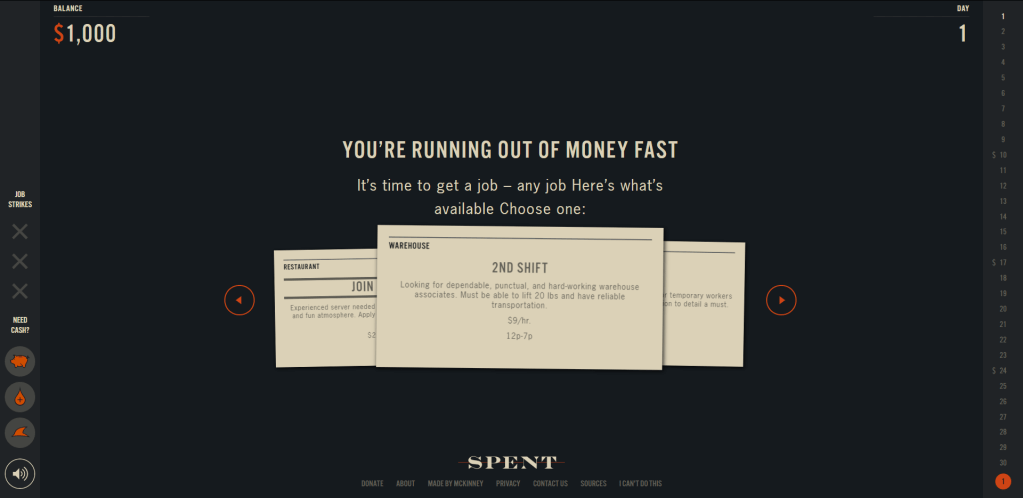
The article on Psychology Today goes through a study that was undertaken by the article’s author, Gina Roussos, to find if the game would have it’s desired effect. After a test involving 54 American Undergraduates and a Control Game called ‘Garbage Dreams‘, Roussos eventually found that the game actually had a negative impact on people’s views on the subject.
Roussos suggests that this is due to the fact that by putting a person into the driver’s seat of these situations it shows them that theses are decision that THEY have control over and any short-comings that then occur are due to their own bad decisions. This feeling of control over one’s outcomes is called “Personal Agency”. It is this feeling that draws people to believe that poverty is personally controllable, and again, is only the result of a person’s decisions.
The example Roussos gives is as follows:
“When I’m playing a game, I feel like I have complete control over my outcomes. I click on Door A instead of Door B, and I find a treasure chest full of jewels. I found that treasure because I choose Door A.”
The above showcases the choice that YOU, the player, picked Door A. Door A happened to contain a treasure chest. But had you picked Door B then you would never have found said treasure.
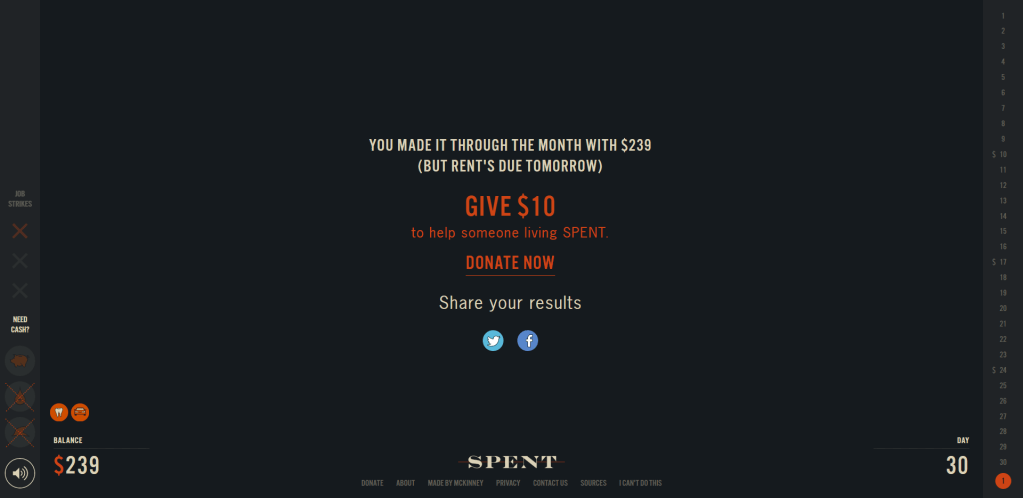
This then provides the inherent problem with the game itself. It pushes the player to make the decisions on the spot without any prior knowledge of the event in question. Then you instantly see the ramifications of your decision, pushing the idea being in poverty is a result of a person’s bad decisions. Henceforth proving that the Game’s intentions are very much different to it’s actual effect.
Roussos then goes on to do another study with 227 U.S. Adults to verify these results. Although apparently when people watched a recording of someone playing the game they reacted in more of a way that the Developers intended. The people viewing the game being played second hand showed a more empathetic view towards people in Poverty than the people actually playing it.
After playing the Game myself for 10-15 minutes I find the game itself to be kind of unreasonable to it’s events and does indeed instil a feeling the opposite of what was intended. I felt like the game was punishing me simply because of the decisions I made NOT because of the situation I was in as a character.
But as for the article it was a very good insight into the intentions of the Game and it’s actual effect on people. It’s also a good insight into the repercussions of not testing out your Game’s effect when it’s effect is the desired outcome.
But that’s it for this week, thanks for reading everyone!
I’ll be back next week with a review of ‘Dwarf Fortress’ by Bay12.
Thanks again!
– Nathan “Naff” Hibbert

 Naff's Gaming Blog